

Login or Subscribe
You must be logged in to access this content
Subscribe for free access to Japanese Exotic Mushroom Journal and gain insider knowledge on effective cultivation methods for Japanese mushroom species. Elevate your skills with expert tips and innovative technologies to master the art of growing Japanese exotic mushrooms.
◆ Discover exclusive Japanese mushroom cultivation techniques
◆ Learn innovative methods to enhance mushroom quality and yield
◆ Tap into Japan's rich heritage for unique growing insights
◆ Discover exclusive Japanese mushroom cultivation techniques
◆ Learn innovative methods to enhance mushroom quality and yield
◆ Tap into Japan's rich heritage for unique growing insights
Subscribe Now for Free Login
The enzymatic power of mushrooms
Applications and possibilities for the circular economy
- Dr. Konno Naotake, Associate Professor, Utsunomiya University, School of Agriculture, Department of Applied Biological Chemistry
This article was first published in the Summer 2024 edition of Mycophagist, and translated from the original Japanese. - IntroductionThe potential of mushrooms is closely connected to environmental issues, and there are plenty of things that can be learned from mushrooms in this regard. Mushrooms, for example, contain many rare enzymes that humans or other living organisms do not. In this article I would like to discuss these mushroom enzymes, which are the subject of my research, whilst linking mushrooms to the idea of the circular economy.What is an enzyme?The reason that we, as living things, are able to maintain life is because of many different enzymes. There exist around 5000 types of enzymes in humans, each performing a different role. An enzyme is, to give it its textbook definition, a protein that functions as a catalyst for chemical reactions. Most enzymes in living creatures function best at 37~40°C, but beyond 42°C enzymes deactivate, and no longer function. The human body is the same: once it gets beyond 42°C we often die, but when we have a fever of around 40°C, our body has created an environment in which enzymes can work best, fighting viruses and bacteria, and raising our metabolism. On the other hand, however, individual enzymes are not particularly versatile; rather, they only react to specific materials, without working on other reactions, a trait known as substrate specificity. It is because of this, by containing many different types of enzyme, biological activity can be maintained.One close-at-hand example is the digestion of starch. I think it is impressive the way in which starch is broken down not simply in one fell swoop with a single enzyme, but through the work of a `right person in the right place` function sharing system through the digestive process: α-amylase contained within saliva shortens randomly the long starch molecules when you eat a food such as rice; and when this reaches the intestines, this shortened starch is further broken down
by maltase and isomaltase into glucose.It is worth noting that the production of enzymes takes energy. That is why there is not always a large amount of amylase contained within saliva, rather it is produced when it is necessary. There have also been experimental results showing that amylase production is more likely to increase when we are stressed. 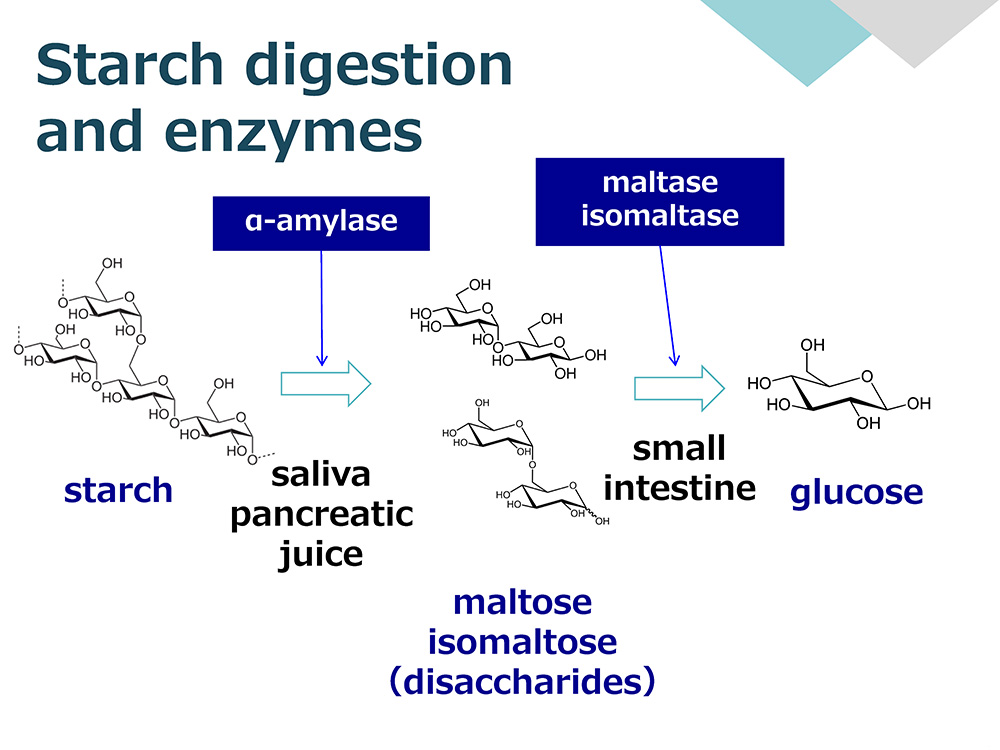
- Figure 1.
- What can mushrooms break down?I often give the following quiz to high school students at the beginning of my lectures: of wood, vegetables, seaweed, crab, cow manure, meat, and rice straw, which can be broken down by mushrooms? Of course, the answer is all of them. They can all be broken down with mushroom enzymes.We can say that if there exists a lot of one type of object on earth, then it exists for a long time precisely because it cannot be broken down. On land, plants, and particularly wood, are hard and difficult to break down. The saprophytic mushrooms that can break down these materials are incredible _endash_ important and rare living organisms amongst those on earth. They can break down all plants including, of course, vegetables and rice. Seaweed and crab can also be broken down.Mushrooms are an organism that, as they spread their mycelia or produce fruiting bodies, undergo stark change in form. This change in form occurs as they break down their own bodies, meaning they contain enzymes capable of decomposing themselves. Mushrooms contain a substance called chitin; given that this is the main constituent of crab shells, mushrooms are therefore able to break down these as well. Mushrooms are good at breaking down sugars, such as starch, and proteins, such as meat, that are required as an energy source and for muscles, and which animals such as humans use to survive. When dealing with fungi in artificial environments, we use sugars and proteins as a source of nutrients. The things that we like, mushrooms also like; it is because of this that they have not given up on those materials found on earth for which there is fierce competition. However, I also wonder if mushrooms have survived and thrived by breaking down materials such as cellulose, in plants, for which there is not fierce competition, taking energy as a carbon source. In my quiz, the one material which humans
can break down is meat; the fact that mushrooms can break down the rest has always struck me as remarkable. Cows eat grass, but they cannot immediately break it down; rather, they put great effort into a repeated process of chewing and grinding it, swallowing it so it can be broken down by bacteria in the cow`s stomach (rumen), and then regurgitated to be chewed on once more. This gives a sense of how difficult plants are to break down, made up as they are of tough
fibres.In the time between the Carboniferous and the Permian period, around 290,000,000 years ago, it is thought that a group of fungi developed that could break down lignin, corresponding to the period in which coal stopped being produced on earth. In this way, mushroom enzymes have the power to change the history of earth and its environment, so it is my belief that they also have a role to play in solving our current environmental problems. 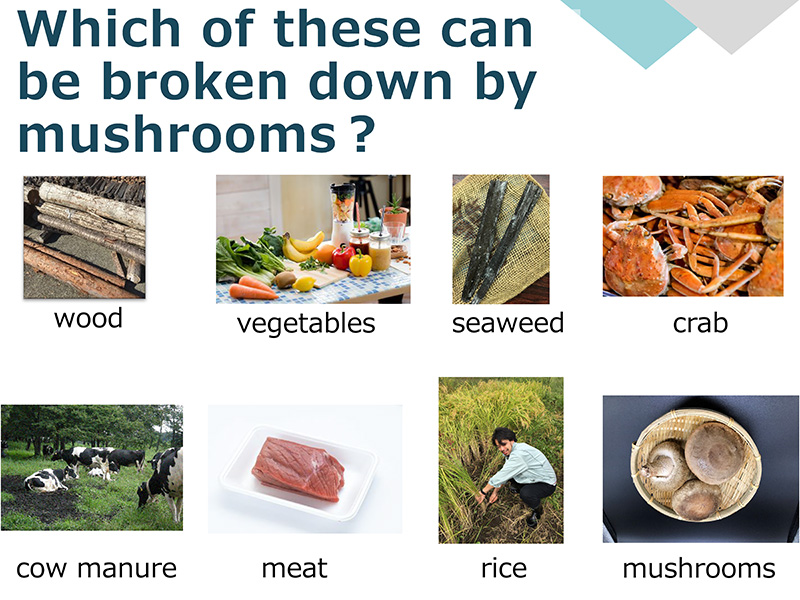
- Figure 2.
- Figure 3.
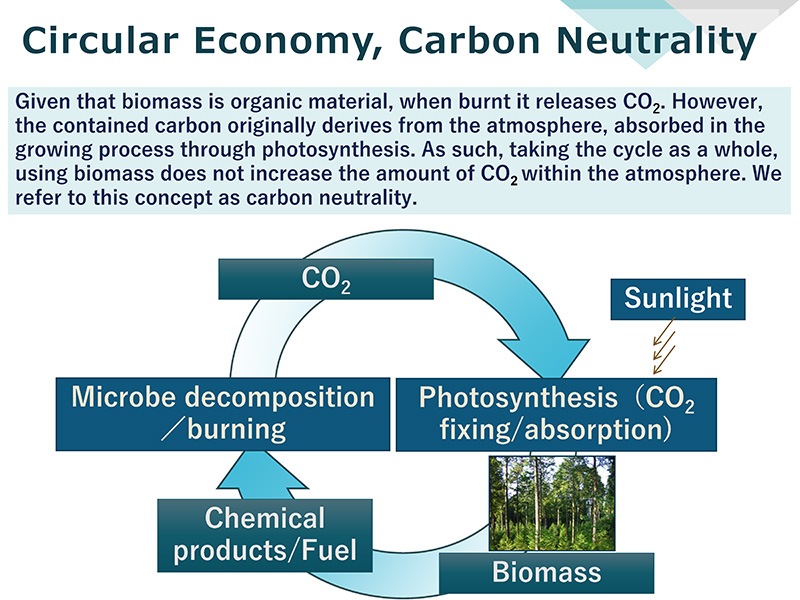
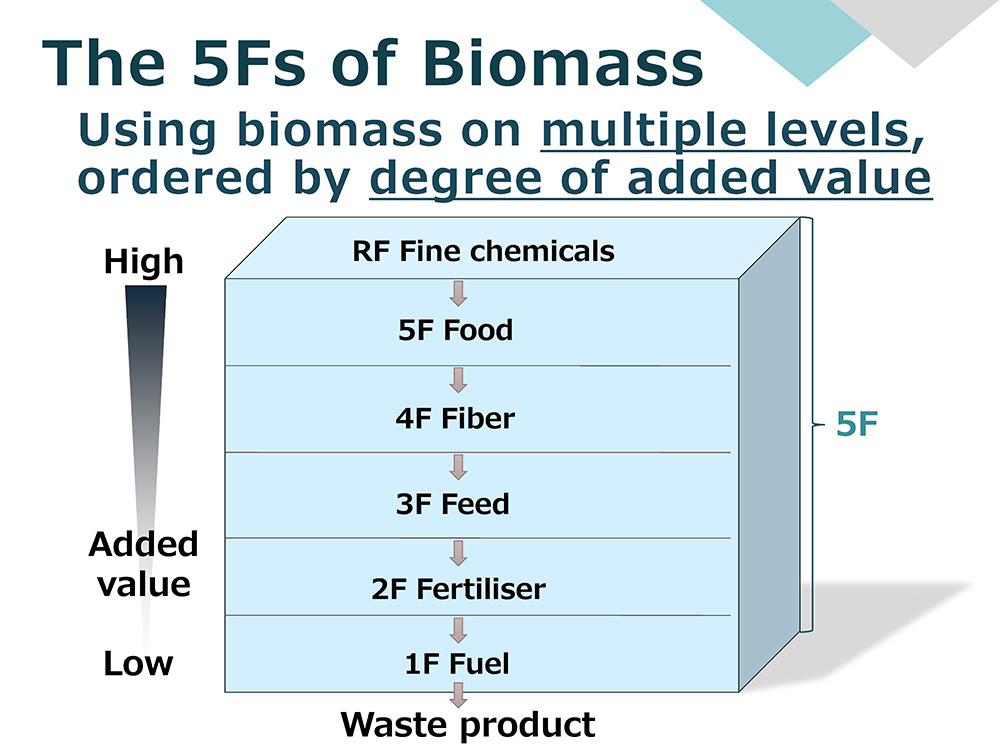
- The enzymatic power of mushroomsI would like to dig into the main topic of this article first by looking at environmental issues and the circular economy; this inevitably connects to the issue of what to do with carbon dioxide. Bioresources _endash_ more commonly known as biomass _endash_ is a word that sits in contrast to the concept of `fossil resources`. Biomass is comprised of organic matter, and so when it is burnt it releases carbon dioxide. However, the carbon in biomass originally comes from carbon absorbed into plants through the process of photosynthesis, so taken as a whole the use of biomass does not increase the amount of carbon dioxide within the system. This concept, known as `carbon neutrality`, has gained much traction in efforts to build a society that no longer increases the quantity of carbon dioxide in the atmosphere. The concept of carbon neutrality relies on the balance between the quantity of carbon being released, and the quantity being fixed; using biomass without thinking about the quantity of carbon being fixed upsets this balance.It is not easy to achieve this balance, and particularly to achieve carbon fixing that fixes the same amount of carbon as is being emitted. To take the example of the Japanese cypress tree, the peak of its photosynthesis occurs during the roughly 15 years immediately after it is planted, with the rate decreasing after this. Even if we use biomass, we will need mechanisms for slowing the speed of carbon emissions, and particularly means of using biomass in a stepped manner before it is turned into waste. In order to achieve carbon neutrality, we will need manufacturing that makes smart use of biomass; delving deeper into what we mean by `smart use`, we often find examples like that shown in Figure 4. Here is shown an illustration of the `5F` use principle, characterised by the production of goods in order from most to least added value, and over multiple levels.The 5F outline proceeds first from the production of fine chemicals, food, and fibre, followed by feed, fertiliser, and fuel; that is, first working to produce goods that can be sold at a high price, and selling proportionate to costs involved. The name of the principle itself is derived from the first letter of each of the elements, all beginning with `F`.
- Figure 4.
- In regards to mushrooms, they contain both components that can be turned into foodstuff s, and those that can be turned into pharmaceutical products. Looking at the 5F illustration, they seem to be an excellent fit for biomass use. Within the category of biomass use, and thinking in terms of quantity, it is important to consider effective ways of using wood. It would be excellent to find uses for wood as pharmaceutical products or food, but consuming it as is, is a difficult proposition. However, we already do gain foodstuffs from wood, through the process of mushroom cultivation. Japanese mushroom cultivation technology has worldwide standing due to its excellence, so I believe using this as a base to move forward will be important. Utilising the ability of mushrooms to develop new products will be vital, not only for food, but for but various other materials, including pharmaceutical products, raw materials, and feed.A short while back there emerged a word `biorefinery`, centred on the US, which referred to operations that, in contrast to an `oil refinery`, make chemical products or energy from organic resources. A key point as part of this is how to break down the main components in wood such as cellulose. While there are more than enough food uses for starch, for example, in comparison I think there is plenty of unused wood and cellulose. If we were able to break this down into glucose, we would then be able to produce plenty from that base material.Plastic is a major environmental issue at the moment, but there also exists a biodegradable plastic called polylactic acid, which is derived from plants. Polylactic acid becomes plastic through the process of turning starch into glucose, using this to produce lactic acid from lactic acid bacteria, and then polymerising the lactic acid into a plastic. In this way, many materials can be made as long as glucose can be derived from plant materials; it is said that of the chemical products or plastics circulating around the world 95% could be replaced in this way. While I have given the example of starch here, in the future it will be necessary to derive these materials not from edible resources but inedible ones, and within that it will be important to be able to break down cellulose.
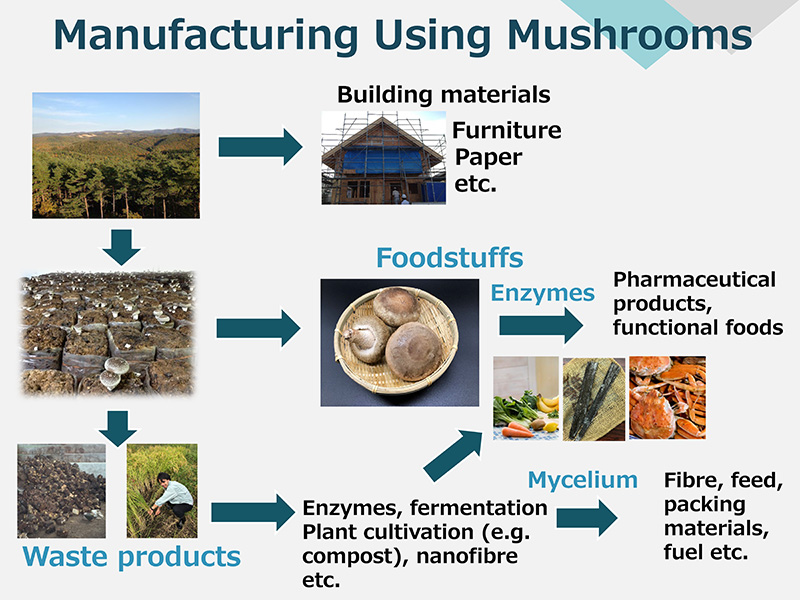
- Figure 5.
- Utilising enzyme researchI would now like to introduce the research we have been doing at our laboratory. The group of mushrooms that break down cellulose do not produce the associated enzyme, cellulase, all the time. For example, if cellulose is placed in a liquid substrate, then they will react and produce cellulase. It is made outside of the fungi, and so if you collect the liquid in the substrate, there will be cellulase present within it. This is known as induction, and points to the importance, in both research and manufacture, of paying attention to how to make a particular fungi produce a desired enzyme. When you have collected only the liquid section there is still a large number of non-cellulase enzymes present, and so the refinement process is also important. In our laboratory we have been thinking about the uses of enzymes and the development of practical applications for them, through repeated extraction, refinement and analysis of enzymes held in various mushrooms _endash_ not only in the mycelium but in fruiting bodies as well.As part of this we have discovered some interesting enzymes. Earlier I mentioned the ability of mushrooms to break down other mushrooms, but there also occurs in post-harvest fruiting bodies a self-decomposition process. If you leave shiitake bought in the supermarket for four days at room temperature, its form changes. One of the main components of the cell walls of shiitake fruiting bodies is a material called β-glucan. Objects derived from shiitake contain both a β-1-3 main chains and partial β-1-6 side chains, and while they have a relatively large molecular weight, they are broken down by an enzyme called β-glucanase. Using this β-glucanase to break down the β-glucans contained with konbu seaweed, we were able to get oligosaccharide, which has immunomodulatory effects. In addition, there is also a material called chitin found within cell walls. We have also found an enzyme that breaks down this chitin, called chitinase. Earlier I talked about the main component of crab shells, but the connected material that is released during the enzymatic process is N-acetyl-glucosamine, which when broken down itself becomes glucosamine, a compound that is familiar to many consumers as it is mentioned in some commercials for health products.As is well-known by many Japanese chefs, in maitake there is an enzyme that breaks down protein, preventing the egg-based chanwanmushi dish from setting when cooked. You can get peptides when breaking down proteins, but amongst these are ones that have shown efficacy in dealing with depression. In addition to these, we have been researching not only food, but also an enzyme known as laccase, which can break down environmental pollutants, and has shown potential to be utilised as a bleach. I wanted to introduce these examples to show how mushroom enzymes can be utilised with biomass, and in product manufacturing.The use of wood is mostly concentrated in building materials and paper, but through mushroom cultivation we also produce food. Whilst agreeing with the point that, in terms of the flow of carbon, this sort of wood utilisation is good, by turning this material not only into food but into pharmaceutical goods, using enzymes to produce functional objects, making styrene foam or leather from mycelium, or finding effective uses for waste material including spent mushroom blocks, I believe it is possible for mushrooms to be a tool connected to the achievement of a circular economy.This English translation was done for the Japanese Exotic Mushroom Journal, and any errors in terminology, transcription, or in the presentation of the data are the responsibility of this journal.


 1-2-13 Honmachi, Komoro city, Nagano prefecture, Japan 384-0026