
Login or Subscribe
You must be logged in to access this content
Subscribe for free access to Japanese Exotic Mushroom Journal and gain insider knowledge on effective cultivation methods for Japanese mushroom species. Elevate your skills with expert tips and innovative technologies to master the art of growing Japanese exotic mushrooms.
◆ Discover exclusive Japanese mushroom cultivation techniques
◆ Learn innovative methods to enhance mushroom quality and yield
◆ Tap into Japan's rich heritage for unique growing insights
◆ Discover exclusive Japanese mushroom cultivation techniques
◆ Learn innovative methods to enhance mushroom quality and yield
◆ Tap into Japan's rich heritage for unique growing insights
Subscribe Now for Free Login
Prepping your body for the coming season with mushrooms
Enhancing health for winter: hypertension and depressive symptoms
Professor YOSHIMOTO HiroakiFirst published in Issue 53 of MP Kinoko Quarterly, the flagship publication of the Japan Kinoko Meister Association.Professor Yoshimoto attained his doctorate in agriculture at Kyushu University and is currently president at Tokyo University of Information Sciences. His specialisations include the correlation between substrate composition and management effects in mushroom cultivation, sixth sector industrialisation, and new product development, marketing, and design.- IntroductionJapan is the land of mushrooms, where the greatest range in the world can be found, with many adorning our meals. Japan is not the only country where a wide variety of both wild and cultivated safe mushrooms are available, is it? Mushrooms are not just ingredients; since ancient times, attention has also been paid to their health benefits. However, the health effects are not only immediate but significant in enhancing health when eaten daily.In this four-part series, I will explain what we can do now to prepare for next season, with a primary focus on health effects. Start incorporating mushrooms into your meals today to help prepare your body for winter. Please note that the mushroom effects I will introduce in this series are merely complementary to any medical care. If you have any symptoms requiring treatment, please follow the directions of your doctor.Preparing for winter in autumn
In my previous article, I focused on the rapid environmental changes of autumn, namely the changes in temperature, humidity, air pressure and daylight hours, and how to deal with them. Winter is a time when these changes come to a halt and it is in winter that it is necessary to address this stagnation.All animal classes have species that hibernate. From mammals such as bears and insects such as rhinoceros beetles, all sorts of animals become inactive and sleep through winter, which means they adopt a strategy of pausing all activities to survive the season. Microorganisms, including mushrooms, and plants also become dormant in order to deal with the low temperature and dryness. This, however, is not something humans do.We need the foresight to prepare for winter, when everything stagnates, in autumn. Bodily changes we need to be mindful of in the stagnant winter include cardiovascular issues like hypertension and mood disorders such as depression, namely those that affect the central nervous system. In this article, I will explain the hypertension and central nervous system mechanism.Mushrooms improve hypertensionIt is known that blood pressure rises in winter. This is caused by exposure to cold temperatures and cold air stimulating the sympathetic nervous system and constricting the blood vessels. Additionally, the increase in the salt content of meals in winter is also said to be a factor. There is a lot of research verifying the effect of mushrooms on high blood pressure with various mushrooms showing this effect. The latest literature reviewing the effect of mushrooms on hypertension cites button mushrooms, oyster mushrooms, shiitake, maitake (hen-of-the-woods), reishi, bunashimeji (beech) mushrooms, chanterelles, cauliflower mushrooms, and enoki mushrooms.The Ministry of Health, Labour and Welfare’s e-healthnet website says that it is crucial to limit the intake of dietary salt. In addition to reducing salt intake, potassium intake is also important for sodium excretion and mushrooms are high in potassium. This is shown in Table 1. Matsutake mushrooms are expensive so if we sideline them, we can see that shimeji mushrooms have the highest potassium content and are accessible. 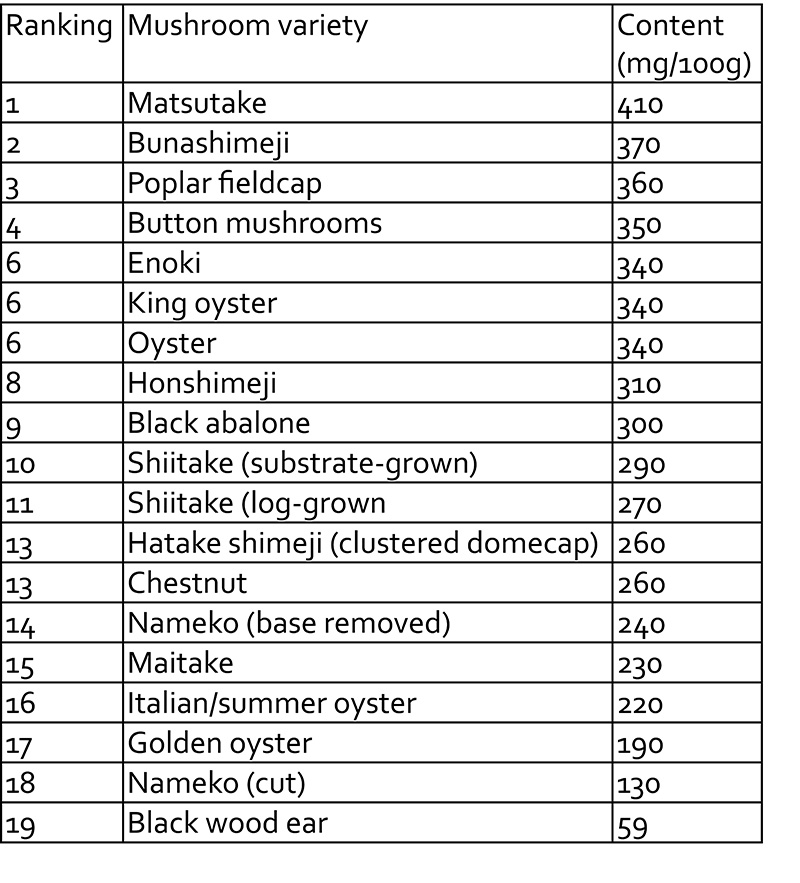
- Table 1. Potassium content of mushrooms.Source: Created from the Ministry of Education, Culture, Sports, Science and Technology’s Food Component Database.
- It is not just the potassium content of mushrooms that is effective on hypertension. Mushrooms also have an inhibitory effect on angiotensin-converting enzymes (ACE). The strength of their inhibitory activity is shown in Table 2, taken from research by Abdullah et al (2012). While bunashimeji was not included in this research, in a paper by Kang et al (2013), its IC50 (the amount required to reduce enzyme activity by half) was 0.19mg/ml. Although the experiment designs differ so it cannot be included in a comparison, comparable effects can be expected. For reference, it has been included in Table 2.Although it is crucial to reduce sodium in meals in winter, doing so diminishes flavour and leaves dishes lacking. To get around this, you can for example add more ingredients to miso soup or make the stock richer. If you use a lot of mushrooms in cooking, their umami components enhance the broth, making for a satisfying dish even with reduced salt.
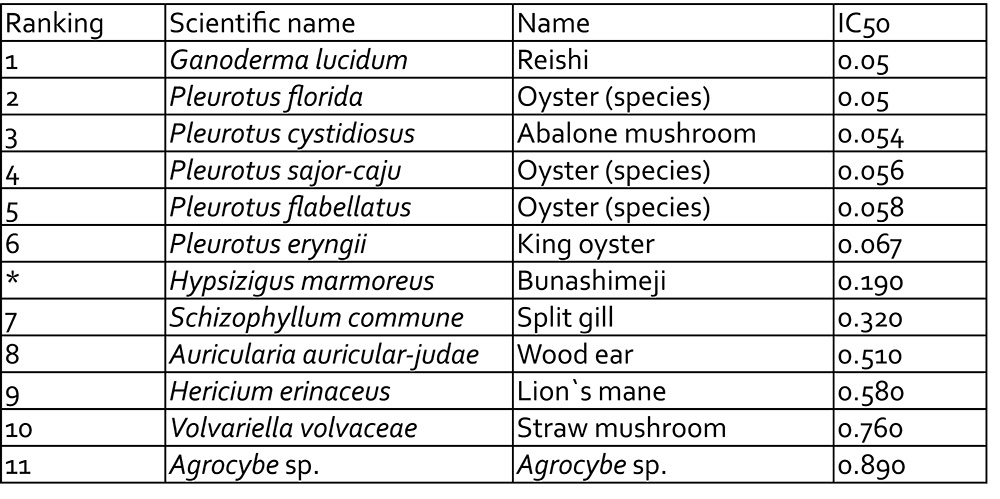
- Table 2. ACE inhibitory activity of mushrooms.
Source: Created from Abdullah et al (2012). The asterisk (*) indicates a comparative value from Kang et al (2013). IC50 is a value where the lower the number, the greater the effect. - Mushrooms alleviate depression and anxietyShorter daylight hours in winter mean reduced secretion of serotonin, a neurotransmitter in the brain that stabilises mood. This can cause depressed mood and other depressive states. Feeling melancholy in winter evenings is not just a matter of mood; it is thought to be caused by stress from environmental changes affecting the central nervous system. The cold also means the sympathetic nervous system dominates, upsetting the balance with the parasympathetic nervous system and thus promoting depressed mood. On top of this, we tend to become more sleep deprived and overworked around the New Year period so we need to be extra careful. Although the season is in a state of stagnation, it may be a characteristic of winter that we become emotionally restless. Everything I talked about in part one of this series about boosting health, improving sleep, and increasing physical strength for summer is also effective for getting ready for winter.Hearing of mushroom’s effect on the central nervous system, some people that have dabbled in biology may wonder if the components of mushrooms reach the brain. To confirm this, my group conducted experiments on mice using almond mushrooms. When we marked a hot water almond mushroom extract with a radioactive substance and administered it orally to mice, we demonstrated that a number of mushroom components absorbed in the digestive tract are transported to the brain and specifically bind to H3 receptors in the brain. Further, because it is known that poisonous mushrooms have hallucinogenic and other effects on the central nervous system, it is clear that mushroom components reach the brain.So, are mushrooms effective on depressive states? The answer is yes. Some psychedelic mushrooms contain psilocybin, a component similar to serotonin. This component is being used in clinical trials in the United States for treatment-resistant depression. However, as mushrooms containing psilocybin are scheduled narcotics, growing and consuming them is prohibited by law so these are not a realistic option.In this regard, the edible mushroom Lion’s mane has been reported to contain hericenones and erinacines, which are nerve growth factor stimulators. Nagano et al (2010) conducted randomised double-blind controlled trials on 30 middle-aged women using Lion’s mane cookies and placebo cookies (not containing Lion’s mane). The results showed that the Center for Epidemiologic Studies Depression Scale (CES-D) and indeterminate complaint index (ICI) improved significantly. The items that improved were listlessness, palpitations, concentration, irritability, and anxiety. It is believed that energy and anxiety are related to neurotransmitters in the brain such as serotonin, which suggests that it may be possible to address seasonal affective depression. It is worth mentioning that the trial participants consumed 2g of dried Lion’s mane daily. This is equivalent to about 20g of fresh Lion’s mane, an amount that can readily be consumed on a daily basis.It has long been told over the generations that mushrooms, as a form of traditional medicine, help blood pressure. On the other hand, research findings showing mushrooms to be effective on depression and anxiety are the latest scientific achievement. They say that “alcohol is the best of all medicines”, but I would rather shout from the rooftops that “mushrooms are the best of all medicines”. The potential of mushrooms is limitless. So this autumn, be sure to enhance your meals with mushrooms to prepare for the long winter nights ahead.
- Professor YOSHIMOTO Hiroaki

- ReferencesAbdullah, N. et al (2012). Evaluation of selected culinary-medicinal mushrooms for antioxidant and ACE inhibitory activities. Evid Based Complement Alternat Med., 464238.Kang, M. G. et al (2013). Characterization of an antihypertensive angiotensin I-converting enzyme inhibitory peptide from the edible mushroom Hypsizygus marmoreus. Biomed Red Int, 6.Ministry of Health, Labour and Welfare (2024). Kōketsuatsu: e-herusu netto (Hypertension: e-healthnet).Ministry of Education, Culture, Sports, Science and Technology (2024). Shokuhin seibun dētabēsu (Food component database).Nagano, M. et al (2017). Reduction of depression and anxiety by 4 weeks Hericium erinaceus intake. Biomed Res, 31: 231-237.Rauf, A. et al (2023). Edible mushrooms as potential functional foods in amelioration of hypertension. Phytother Res. 37: 2644-2666.Yamada, S et al (2003). Baiyō himematsutake (CJ-01 kabu) shijitsutai nessui chūshutsu busshitsu no shinkei dentatsu busshitsu juyōtai, toransupōtā oyobi kanyakubutsu taisha kōso ni taisuru sayō (Effects of hot water extract from cultured Agaricus blazei (CJ-01) fruiting bodies on neurotransmitter receptors, transporters and hepatic drug-metabolizing enzymes. J. Trad. Med., 20:221-229.This English translation was done for the Japanese Exotic Mushroom Journal, and any errors in terminology, transcription, or in the presentation of the data are the responsibility of the Japanese Exotic Mushroom Journal.About the Translator: Naomi Roulston has over a decade of experience as a Japanese to English translator and specialises in food, mushrooms, nutrition and lifestyle medicine, and travel and tourism. She has a postgraduate degree in translation, is NAATI-certified, and holds a Kinoko Meister certificate from the Japan Kinoko (mushroom) Meister Association.


 1-2-13 Honmachi, Komoro city, Nagano prefecture, Japan 384-0026