
Login or Subscribe
You must be logged in to access this content
Subscribe for free access to Japanese Exotic Mushroom Journal and gain insider knowledge on effective cultivation methods for Japanese mushroom species. Elevate your skills with expert tips and innovative technologies to master the art of growing Japanese exotic mushrooms.
◆ Discover exclusive Japanese mushroom cultivation techniques
◆ Learn innovative methods to enhance mushroom quality and yield
◆ Tap into Japan's rich heritage for unique growing insights
◆ Discover exclusive Japanese mushroom cultivation techniques
◆ Learn innovative methods to enhance mushroom quality and yield
◆ Tap into Japan's rich heritage for unique growing insights
Subscribe Now for Free Login
Prepping your body for the coming season with mushrooms
Enhancing health for spring: hay fever
Professor YOSHIMOTO Hiroaki- First published in Issue 56 of MP Kinoko Quarterly, the flagship publication of the Japan Kinoko Meister Association.Professor Yoshimoto attained his doctorate in agriculture at Kyushu University and is currently president at Tokyo University of Information Sciences. His specialisations include the correlation between substrate composition and management effects in mushroom cultivation, sixth sector industrialisation, and new product development, marketing, and design.
- IntroductionJapan is the land of mushrooms, where the greatest range in the world can be found, with many adorning our meals. Japan is not the only country where a wide variety of both wild and cultivated safe mushrooms are available, is it? Mushrooms are not just ingredients; since ancient times, attention has also been paid to their health benefits. However, the health effects are not only immediate but significant in enhancing health when eaten daily.In this four-part series, I will explain what we can do now to prepare for next season, with a primary focus on health effects. Start incorporating mushrooms into your meals today to help prepare your body for winter. Please note that the mushroom effects I will introduce in this series are merely complementary to any medical care. If you have any symptoms requiring treatment, please follow the directions of your doctor. In this, the final part of the series, we will examine hay fever.Spring: the hay fever season
With the advent of spring, hay fever starts to become a topic of concern for family members and others around us. It is almost even something of a conversational byword now for the coming of spring. Hay fever is an allergy that causes symptoms in the eyes, nose, throat and skin; the number of people suffering from hay fever in Japan is increasing year on year, and by 2019 was thought to be at around 42.5% of the population. In particular, the percentage of those suffering from Japanese cedar pollinosis - an allergic reaction to the pollen from the Japanese cedar (Cryptomeria japonica) - was at 38.8% and is rising. The medical cost of treating allergic rhinitis, which hay fever is included under, has been estimated in recent data to be at around 360 billion yen (around 2.4 billion dollars) for healthcare services provided by insurance (around 190 billion yen on medical treatment, and 170 billion yen on provided medicine), and around 40 billion yen (around 265 million dollars) spent on over-the-counter drugs. We can perhaps even refer to it as the `national disease of spring`. The problem of hay fever is also a concern of the Japanese government, with not only the Ministry of Health, Labour and Welfare but also, through initiatives such as the development of cedar species that do not produce pollen, the Ministry of Agriculture, Forestry and Fisheries, the Ministry of the Environment, and the Ministry of Land, Infrastructure, Transport and Tourism embarking on combined measures to deal with the issue. The problem of hay fever, then, is one big enough to have garnered the attention of even the government.When pollen enters the body, it binds with IgE (immunoglobulin E) antibodies that exist on the surface of the mast cells of the nasal mucous membrane. Through the binding of antigen (pollen) and antibody (IgE), the mast cells activate and release chemical messengers such as histamine and leukotriene. The released histamine stimulates the nasal mucus membrane and the conjunctiva of the eye, producing allergic reactions such as sneezing, a runny nose, and itchy eyes. While this series of allergic reactions is just one part of our body`s natural defence system as it seeks to remove foreign objects entering our body such as pollen, for those people suffering from hay fever these reactions are excessive, such that symptoms are serious to the extent that they hamper our day-to-day lives. Antihistamine, steroids, antileukotriene, Chinese herbal medicine, or biologics (for severe sufferers) are mainly used as treatments for hay fever. Whilst mushrooms do not have the immediate effectivity of pharmaceutical drugs, there are mushrooms that have been confirmed, through research, to be effective in easing hay fever symptoms. - Mushrooms improve allergies
As stated above, sufferers of allergies such as hay fever and atopic dermatitis often have elevated IgE levels. On the other hand, a separate immunoglobulin called IgA is also abundantly present on mucus membranes in the nose, throat, and alimentary canal, and prevents allergens such as pollen fromentering the body. Mushrooms are thought to increase IgA, and therefore be effective in dealing with allergies.Nishimoto et al (2023) conducted a parallel group study on 80 healthy participants, getting them to consume hot water extract powders from the fruit of a mixture of maitake, eryngii, and bunashimeji (equivalent to the daily consumption of 50g of fresh mushrooms per day). The results showed that, for the group that consumed the mushrooms, their levels of IgA were much higher. From this result we can see how for hay fever sufferers the consumption of mushrooms can effectively prevent the negative impacts of pollen.Effectiveness of enoki ice on hay feverThere is a product available called `enoki ice` which those familiar with the mushroom industry may be aware of. It is an enoki-derived food made by taking fresh enoki mushrooms and blending them with water in a mixer, before boiling them down and allowing them to be frozen in blocks; doing so physically breaks down the cell walls of the enoki allowing the components of the enoki to be easily dissolved, with the heat breaking down the molecules of the effective components to allow them to be easily absorbed. Because it is so easy to make at home, I recommend this product to many people.Our research group conducted human clinical trials on 21 volunteers (male and female) who had been diagnosed with hay fever either through medical interviews or blood tests, having them regularly consume enoki ice (the equivalent of 50g of fresh mushroom). We started the trial just as hay fever symptoms were set to get worse, setting it such that the rough peak of pollen count occurred after two months of consuming the enoki ice.The results are shown in Figure 1. The IgE total, which we can take to be the cause of the hay fever symptoms, decreased markedly for both men and women for the group that consumed enoki ice when taking the initial value as zero (solid line). On the other hand, for the group that did not consume enoki ice, the value increased from its start plenty of fibre. Of this, a substance called β-glucan in particular activates intestinal cells and gut microbiota, promotes balance, and regulates immune response. This β-glucan acts on immune cells and, through this, is thought to promote antibody balance, is the general term for the substances that make up the cell walls of mushrooms, and exist universally in them. As such, for people point (dotted line). It shows how the increase in IgE for the group that did not consume enoki ice correlates with the worsening of symptoms at the peak of hay fever season. Furthermore, the CRP (C-reactive protein) value which shows the level of inflammation in the body showed no change in the average value even if there were participants with elevated values; for the group that consumed enoki ice, however, the values were markedly lower, and suggest that relevant inflammation is being suppressed. 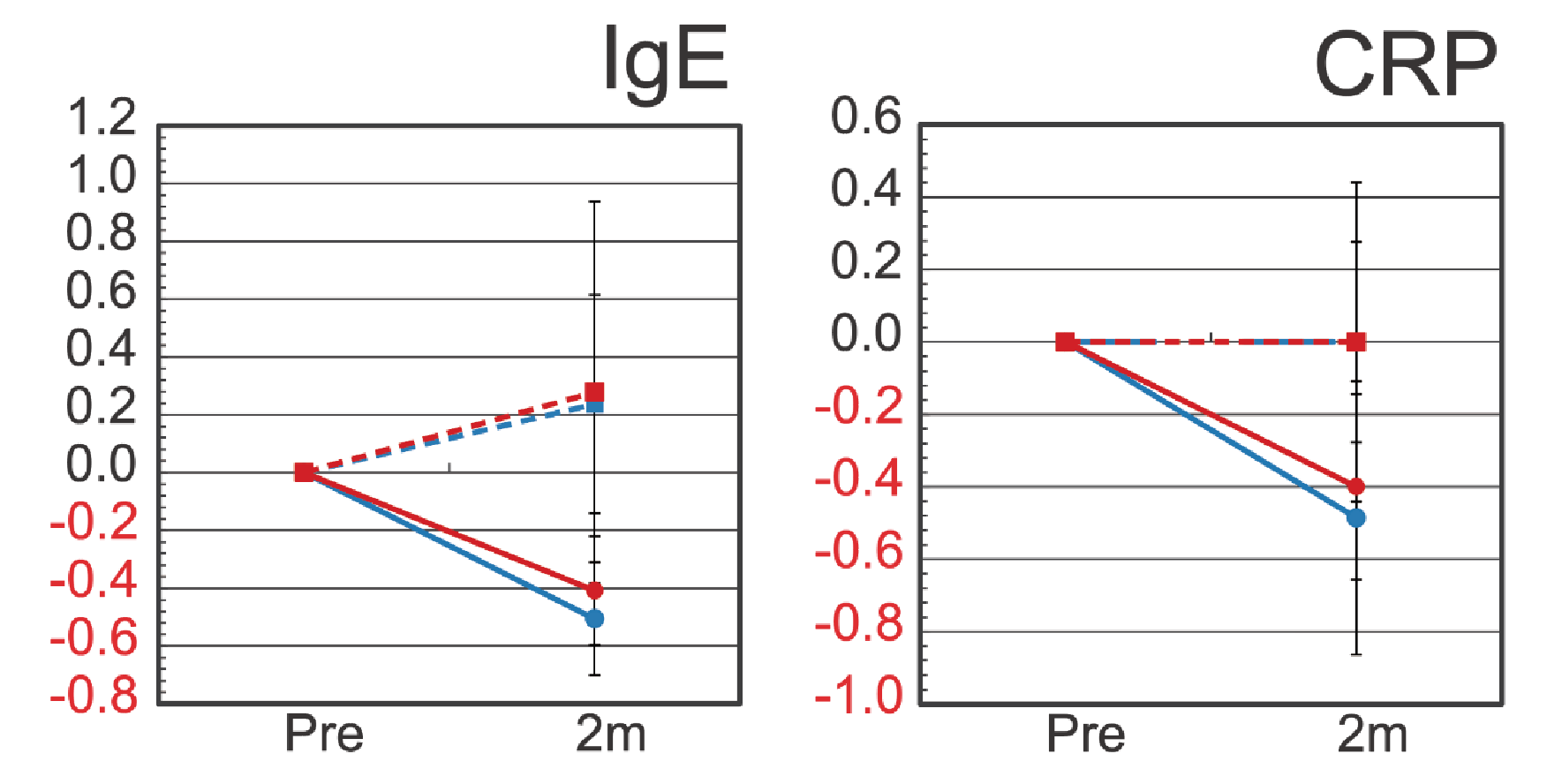
- Figure 1. The effectiveness of enoki ice on hay fever: changes in IgE and CRP
The straight lines represent the group who consumed enoki ice, and the dotted lines the group that did not consume enoki ice. Red lines show female participants, and blue male participants. `Pre` shows the blood values prior to consuming enoki ice, with the table comparing deviation from these initial values from a base line for each participant of zero. `2m` is the value taken after two months of consuming enoki ice. Three blocks of enoki ice (equivalent to around 50g of fresh enoki) were consumed each day. Values shown are averages and standard deviations. - Mushrooms improve gut healthMushrooms are a foodstuff that contain who eat mushrooms on a regular basis, we can expect a reduction in the symptoms of hay fever and other allergies. Furthermore, there is also research that mushroom fatty acids are similarly effective. However, looking at this research together, it is vital that daily consumption of fresh mushrooms exceeds 50g.Hay fever is an ailment prevalent throughout the population, and is increasing year on year. Whilst the available options for improving symptoms have certainly increased, with the development of new medicines, I think it is even better if a helping hand can be found on the dinner table as well. The possibilities of mushrooms are endless. I hope that you have a healthy start to the new year, with mushrooms on your plate. If, through this year of articles, you have been able to get a sense, even slightly, of the wonder of mushrooms, then I have done my job. A great thank you to you, the reader, for joining me with these articles over the past year.
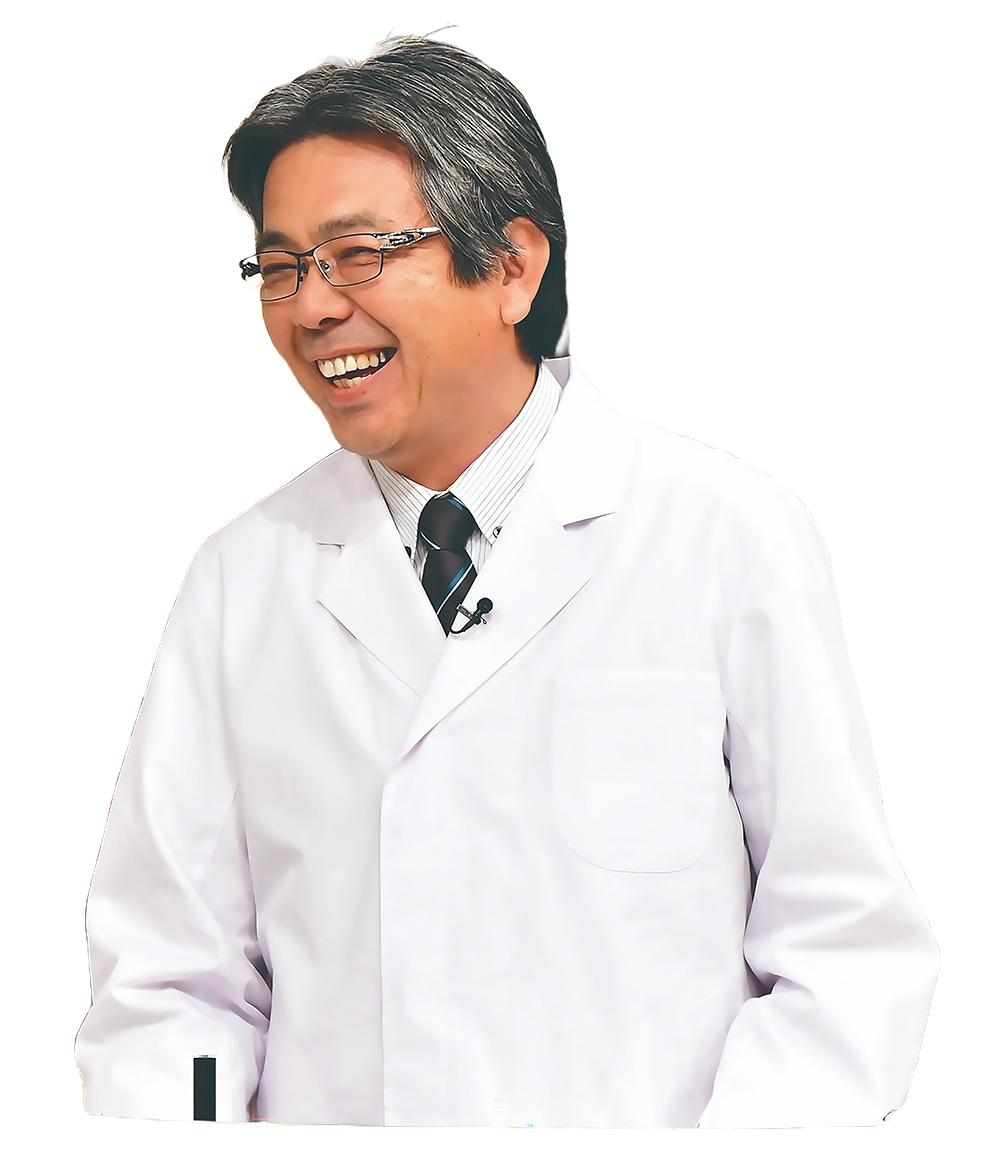 Professor YOSHIMOTO Hiroaki
- ReferencesMinistry of Health, Labour and Welfare (2023). Kafunshō taisaku (Measures to deal with hay fever). 1st Meeting of Relevant Cabinet Ministers Regarding Hay Fever.Nishimoto, Y., Kawai, J., Mori, K., Hartanto, T., Komatsu, K., Kudo, T., and Fukuda, S.: Dietary supplement of mushrooms promotes SCFA production and moderately associates with IgA production: A pilot clinical study. Front Nutr. 9, 1078060 (2023).Yoshimoto, H., Miyazawa, N., Ichimura, M., Eguchi, F., and Matsuda, T. (2012). Enoki gōri no sesshoku ni yoru kōarerugī kōka (anti-allergy effects of consumption of enoki ice). Abstracts of the Annual Meeting of JSMSB, 16:127.This translation was done for the Japanese Exotic Mushroom Journal, and any errors in terminology, transcription, or in the presentation of the data are the responsibility of this journal.


 1-2-13 Honmachi, Komoro city, Nagano prefecture, Japan 384-0026