
Login or Subscribe
You must be logged in to access this content
Subscribe for free access to Japanese Exotic Mushroom Journal and gain insider knowledge on effective cultivation methods for Japanese mushroom species. Elevate your skills with expert tips and innovative technologies to master the art of growing Japanese exotic mushrooms.
◆ Discover exclusive Japanese mushroom cultivation techniques
◆ Learn innovative methods to enhance mushroom quality and yield
◆ Tap into Japan's rich heritage for unique growing insights
◆ Discover exclusive Japanese mushroom cultivation techniques
◆ Learn innovative methods to enhance mushroom quality and yield
◆ Tap into Japan's rich heritage for unique growing insights
Subscribe Now for Free Login
Movin` on up
New horizons for Sakato Sangyo with the opening of their latest factory
- Sakato Sangyo remains a key supplier for numerous mushroom growers around the world, providing cultivation bags that are a basic building block for cultivation of a wide variety of exotic mushroom species. Whilst not as fl ashy as some of the machinery that is used in the automation process, bags are the backbone of reliable, consistent, quality growing; for Sakato Sangyo, the qualities that make a good cultivation bag _endash_ perfectly sealed, consistent thickness and weight, tailored to the species and growing style being used _endash_ are the result of a well-thought-out production process, a constant eye towards the needs of mushroom producers, and continual improvement. As Sakato Sangyo gears up to increasing production in their state-of-the-art new factory, I took the opportunity to visit their home in Gunma prefecture and talk to their CEO Kōta Obuchi about these fundamental manufacturing principles, and to see how they are maintaining excellence as they scale up, making bags the Sakato way.
- Sakato Sangyo: changing with the timesSakato Sangyo began operations in 1998, coming into an already well-developed domestic Japanese mushroom industry. The low cost and high quality of mushrooms demanded by consumers in Japan meant fine margins for producers, for whom negligible contamination rates and consistency in blocks was a non-negotiable baseline. Into this, Sakato Sangyo emerged as a leading player, bringing in technological expertise and a focus on perfecting and controlling as much of the manufacturing process as possible, even down to the plastic mix they use to produce film with their own inflation machines, which they have been doing for over 20 years. This approach, focused on consistency and reliability, allowed them not only to carve a space for themselves in a highly competitive Japanese market, but become the top mushroom cultivation bag producer in Japan.Eight years ago, the qualities that have been so important for a Japanese market started to garner attention from international producers; Sakato Sangyo has now become a leading supplier of cultivation bags across the world, based on this fundamental commitment to consistency and reliability. As producers look to scale up, these smaller margins start to make all the difference, removing the work of having to deal with contamination caused by poor bag or filter seals, or uneven plastic that does not always work with machinery in the same way. Furthermore, the flexibility that is built into Sakato`s manufacturing process has allowed them to tailor their output to the different needs of producers in different parts of the world, whilst maintaining quality. This is evident in their wide offering: five different bag sizes, a wide variety of bag thicknesses in both polypropylene and polyethylene (as well as specialty black bags to control fruiting location on the block, and extra tough bags to reduce the possibility of pin holes even with rougher substrate), and four different filter types. Furthermore, controlling the plastic mix for their film, and with the deep technical expertise to back it up, has allowed them to meet the changing needs of the international market which, along with their commitment to consistent high quality, has allowed them to stay on top over their 27 years in the business, and sell almost 1 billion bags.
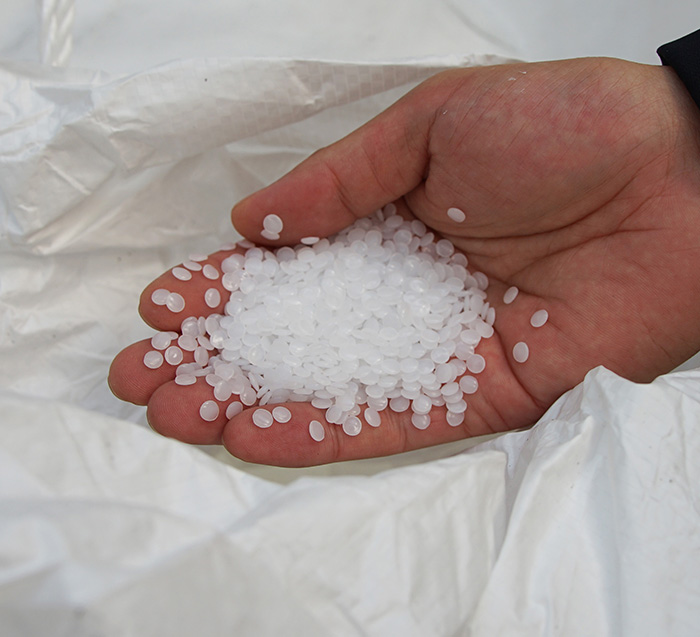 One of the many different types of raw plastic material Sakato Sangyo uses to make their film from scratch.
- Ramping up production, maintaining flexibility
The latest step in the Sakato Sangyo story is the opening of a new state-of-the-art factory, spurred by burgeoning international demand. As Mr. Obuchi told me, the new factory has been on the cards for a few years, with careful planning involved to allow increased production whilst maintaining commitment to quality and flexibility. Construction began earlier this year, with the completed new facility completed in early autumn, and the first machines moved in soon afterwards.As Mr. Obuchi showed me around the ready-to-produce new factory, what struck me first was just how spacious it was. While only the first few machine lines were moved in when I visited, Kōta Obuchi told me that the maximum yearly production for the new factory when up to full capacity was a staggering 150,000,000 bags per year (more than twice the previous yearly output of the entire operation). Furthermore, these would be made using the latest machinery making use of precision technology, ensuring that the quality that Sakato Sangyo is known for is carried forward even with a ramp up in production. 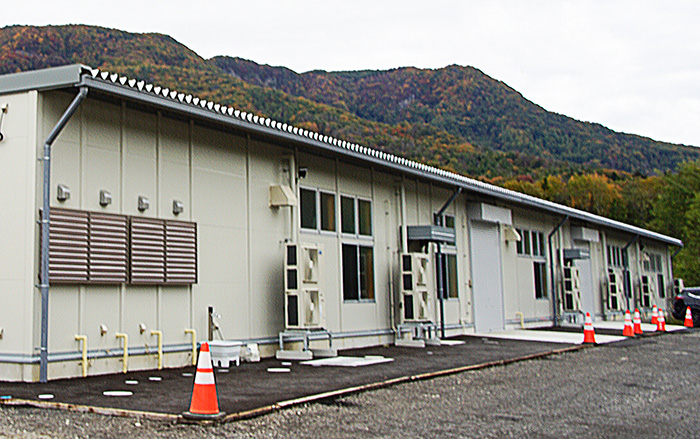
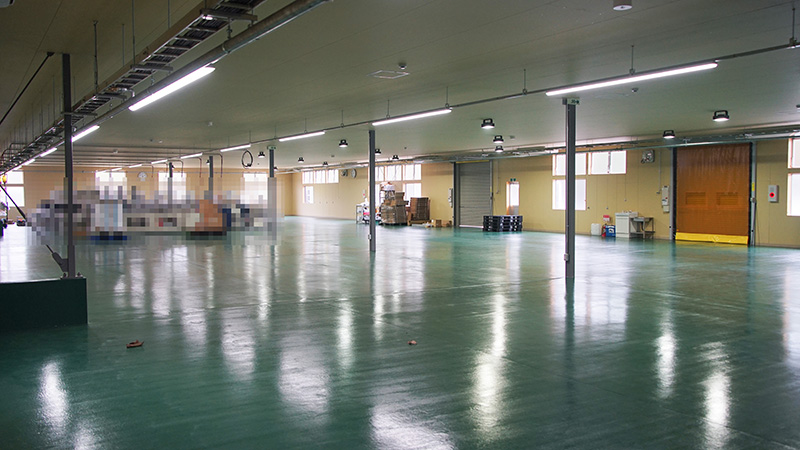
- Sakato Sangyo`s new factory, ready for production. Above: the outside of the factory set against the Gunma mountains. Below: the inside of the factory ready to be filled with state-of-the-art machinery.
- Simply upping production quantity would be meaningless if it did not intersect with the fundamental principles on which Sakato Sangyo has built their business. Just as with their bags produced up to this point, the facility has been designed to produce a wide variety of bags in their lineup, allowing them to shift production to meet the demands of a customer base overseas, that might have markedly different needs from growers in Japan. A particular focus has been placed in the new factory on non-standard (in Japan) bag sizes, and in particular L and XL bags that have been popular in growing in places such as North America. While it would have been easy to simply get a factory built and increase production to meet demand, Sakato Sangyo have taken their time, making sure efficiency and growth intersect with an understanding of what their customer base needs, and how that might change in the future.An ongoing commitment to improving qualityJapan has a well-deserved reputation for quality in craft and manufacturing, built upon long-term, focused dedication to easy-to-overlook parts of production, and a refusal to sacrifice quality for short-term profits. We have covered in the JEMJ before how this is reflected at Sakato Sangyo, with the various checks that they have in place to ensure quality: continual inspections on bag thickness, filter seal, bag seal, and bag dimensions that are carried out on the factory floor to ensure that even when minor variations do occur, they can be caught and weeded out quickly. Visiting Sakato Sangyo`s factory floor the way in which these checks are incorporated into the flow of production is clear, with workers moving back and forth between inflation and bag machines, ensuring that everything is finely tuned.
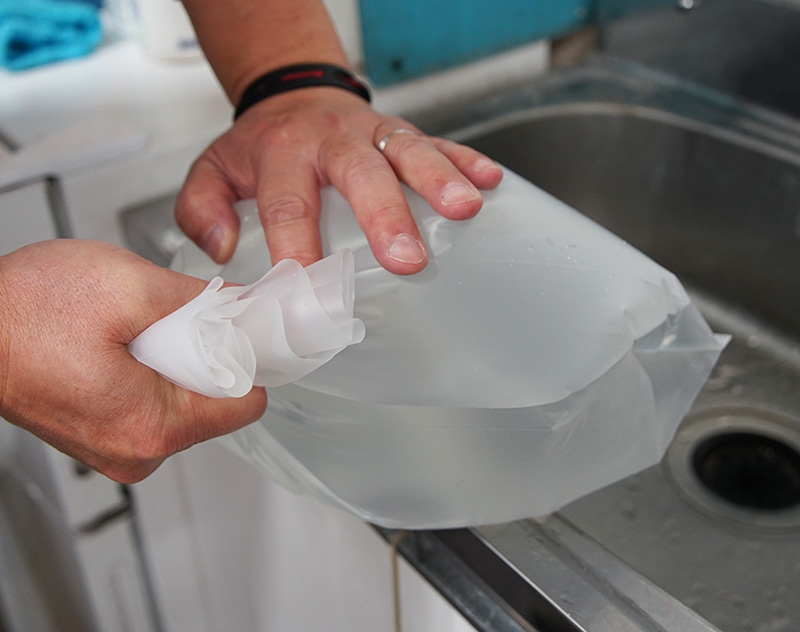
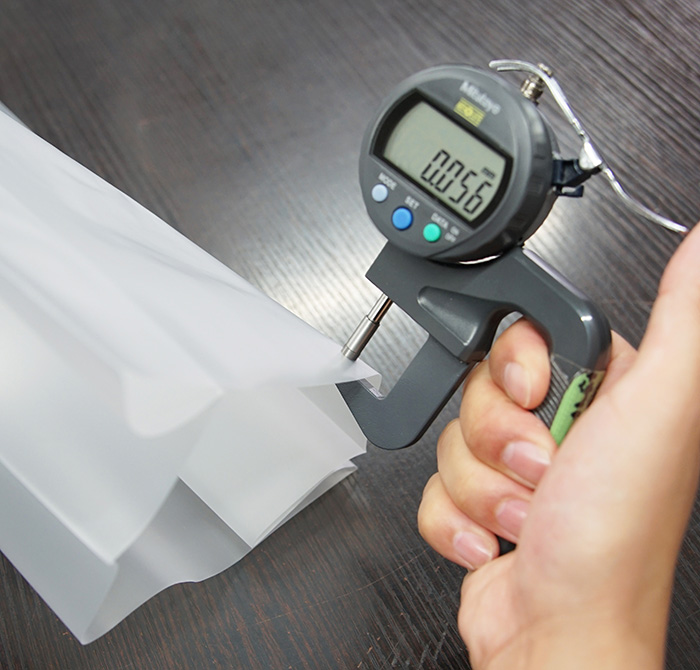
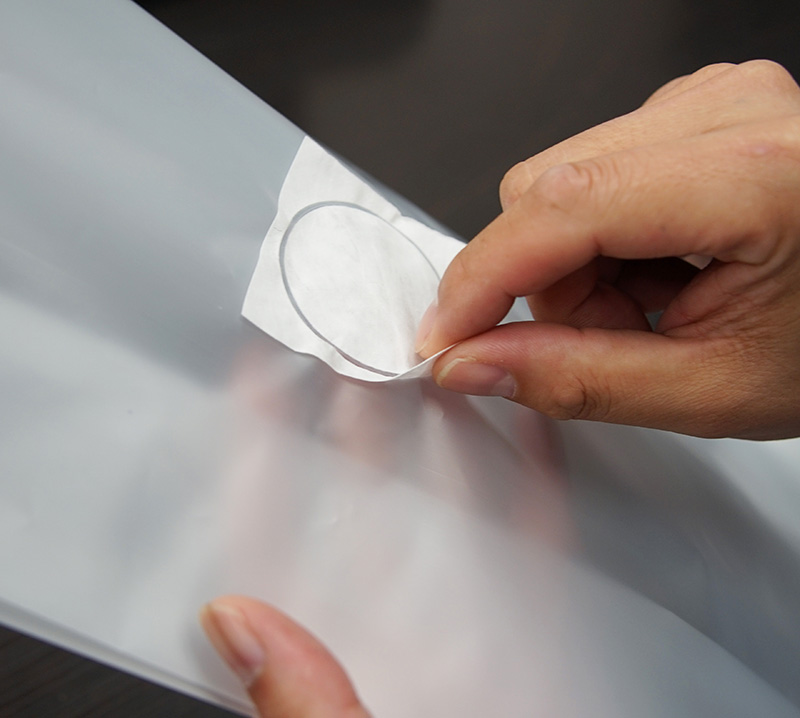 Three of the checks conducted at Sakato Sangyo on their bags, to ensure correct bag sealing, thickness, and filter adhesion.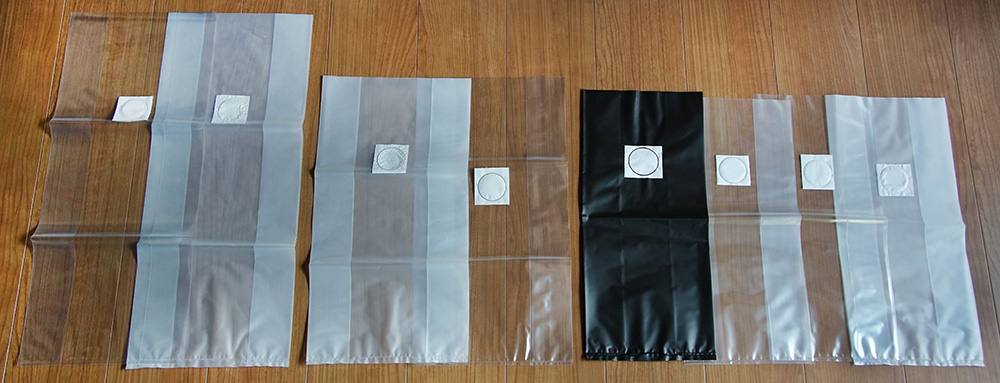
- A selection of the many bags on offer to mushroom growers around the world, tailored to specific needs. Pictured are bags in M, L, and XL sizes, both PE and PP, and specialty bags such as black bags and extra tough bags.
- This is not simply `quality for quality`s sake`: for mushroom producers looking to increase their bottom line, making use of high-quality bags is an easy way to make a difference without large capital expenditure. Even a small level of defects in bags that make it to the growing room can mean lost time and money as blocks do not fruit, or are thrown away. The fine margins in Japanese mushroom farms have been made possible, for example, by very low rates of contamination, in large part due to the use of reliable cultivation bags. In the end, this has a direct impact on the viability and profitability of a growing operation, particularly when working at larger scales.Sakato Sangyo`s focus on quality is not simply a static baseline, either. Rather than simply a set of unchanging rules for checking quality that are implemented and repeated unthinkingly, Sakato`s commitment to quality is ongoing, as they search for ways to reduce rates of defective bags, even when they know that they will be picked up anyway. Kōta Obuchi proudly told me that even with very low rates of defect bags, recent initiatives had reduced this further; such fine margins
would be easy to overlook, especially if making use of imported plastic film where they would have no control over quality. For Sakato Sangyo, however, there is both the means and the will to dedicate themselves to further improvement.In this way, Sakato Sangyo are not resting on their laurels, but always looking for ways to keep moving forward. It is with pride that SALAI International Japan supplies Sakato bags, safe in the knowledge there is no one doing it better.


 1-2-13 Honmachi, Komoro city, Nagano prefecture, Japan 384-0026