
Login or Subscribe
You must be logged in to access this content
Subscribe for free access to Japanese Exotic Mushroom Journal and gain insider knowledge on effective cultivation methods for Japanese mushroom species. Elevate your skills with expert tips and innovative technologies to master the art of growing Japanese exotic mushrooms.
◆ Discover exclusive Japanese mushroom cultivation techniques
◆ Learn innovative methods to enhance mushroom quality and yield
◆ Tap into Japan's rich heritage for unique growing insights
◆ Discover exclusive Japanese mushroom cultivation techniques
◆ Learn innovative methods to enhance mushroom quality and yield
◆ Tap into Japan's rich heritage for unique growing insights
Subscribe Now for Free Login
Meet the growers: Yairo Shiitake
Series Overview
Our `Meet the growers` series remains a key part of the Japanese Exotic Mushroom Journal`s article selection, allowing a glimpse into the varied world of Japanese mushroom cultivation through tours of different farms across the country, showcasing the successes and difficulties that growers of different scales and species deal with. For this edition we visit Yairo Shiitake, a shiitake producer in snowy Niigata prefecture, looking at how the producer cooperative balances innovation and stability within a complex organisational structure.- IntroductionOne of the results of a highly developed national mushroom industry in Japan is the existence of `rules of best practice` that can make it difficult for producers to stand out in the market. Optimal substrate mixes, growing conditions, harvesting and sorting practices etc. have been `worked out`, so to speak, leaving little wiggle room to find a gap in the market. This is not to say that there are not innovations within the industry - this series has frequently covered the small ways in which quality, locality, efficiency and so on have been utilised to great effect by growers both large and small - but there is always an element of risk in moving outside of the mainstream, where making large changes can mean losing out, if things do not go to plan.This edition`s `Meet the growers` shows a glimpse into one way in which iteration and innovation can exist without excess risk, and within a well-developed growing industry. The Japanese Exotic Mushroom Journal visited a farm dealing with a well-known and long-grown mushroom, Yairo Shiitake, to look at how strength and stability for a mushroom cultivation business can come not only from a single selling point, but from strengths built into organisational structure.Yairo Shiitake
The distinctive position of Yairo Shiitake is obvious before even setting foot in any of its polytunnels, incubation rooms, or offices. Located in the rural city of Minamiuonuma, within the prefecture of Niigata and towards the Japan Sea coast, it differs from most of the farms the JEMJ has visited through the `Meet the growers` series history; while it is usual for farmers to have different facilities located in separate areas, the disparately located polytunnels, pointed out by our trustworthy guide and distinct in their same shape and size, were a more spread-out and dominant presence in the landscape, located in pockets between fields, buildings, and public roads. Still covered in a hefty amount of snow (the area having some of the heaviest snowfall not just in Japan, but on the planet), these smart polytunnels gave the impression not of a single `farm`, but an integrated network woven into the local area. 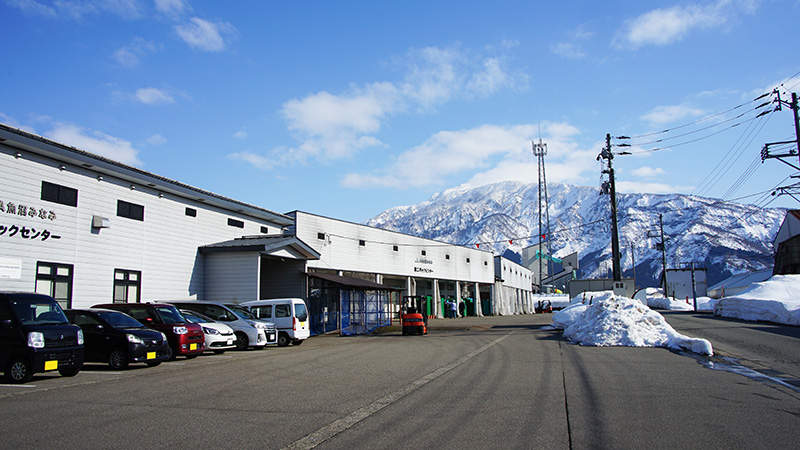
- View of the sorting and packing centre for Yairo Shiitake, with the snowy Niigata mountains as a breathtaking backdrop.
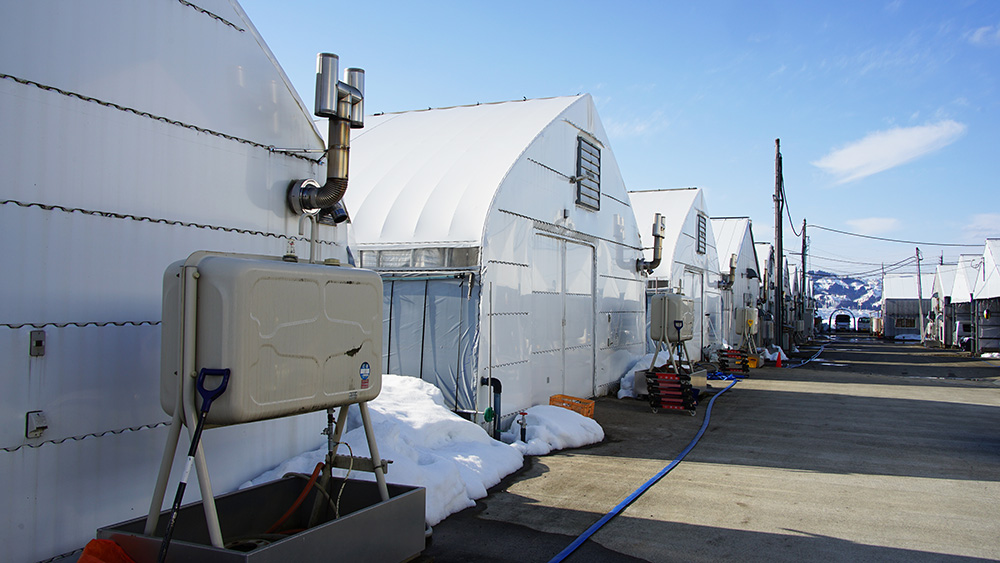
- A line of smart fruiting rooms, part of one of the many farms that make up the producer cooperative. Many of these are built and leased to producers, saving initial investment costs.
- This integration between farm and area was also evident at the heart of the operation, a collection of buildings close to many of the polytunnels, and sat on either side of a public road. It was in these central offices that the JEMJ got a chance to sit down and talk with the Managing Director of Yairo Shiitake, Komagata Nagayuki, and Deputy Managing Director, Katō Yōhei. Both young (unlike much of the ageing Japanese agricultural industry), Mr. Komagata and Mr. Katō were energetic and jovial, but with a clear-eyed focus on their operation, and what was required to survive (and thrive) in the Japanese mushroom industry in 2026.First, however, to the background: Yairo Shiitake initially started out as a shiitake log cultivation operation in 1981, in order to make a living during the long agricultural off season, a common origin story for many mushroom farmers in rural areas. Shortly after this, Yairo Shiitake shifted into a producer cooperative, bringing together 9 different cultivators together into one organisation. This basic cooperative structure has defined Yairo Shiitake over the past forty years, despite expansion and change, through the wholesale shift from log to block cultivation in the early 1990s, and in partnership with Japan Agriculture, the nationwide agricultural cooperative that often provides a link to markets for producers.Yairo Shiitake now runs with a complex sharing of responsibilities between the three different stakeholders. Mr. Komagata explained how the cooperative management takes a central role in terms of overlooking the movement of substrate and product to and from producers: filling, sterilising, and incubating the blocks up to the first stage (around 50 days) before they head to the individual producers; as well as receiving the harvested shiitake to sort and pack them. The 11 producers that currently form the cooperative take the blocks after the first stage of incubation, and `brown` the blocks up to a full 120 days of incubation, before harvesting them over seven flushes. Finally, the Japan Agriculture cooperative provides a connection to wider markets, as well as being involved in the building and leasing of some of the key infrastructure required.While a complex sharing of responsibilities, this cooperative structure has allowed Yairo Shiitake to expand into one of the largest shiitake producers in the region, supplying well over half of the supply in the prefecture, and 2.5% across the country as a whole. Every day more than 6000 blocks are filled, sterilised and incubated, adding up to 1.5 million every year, and 1400 tons of mushrooms shipped to consumers. This large production is made possible by a comprehensive workforce: in total, almost 200 employees work within the cooperative structure, split between the cooperative management, and the growers themselves.
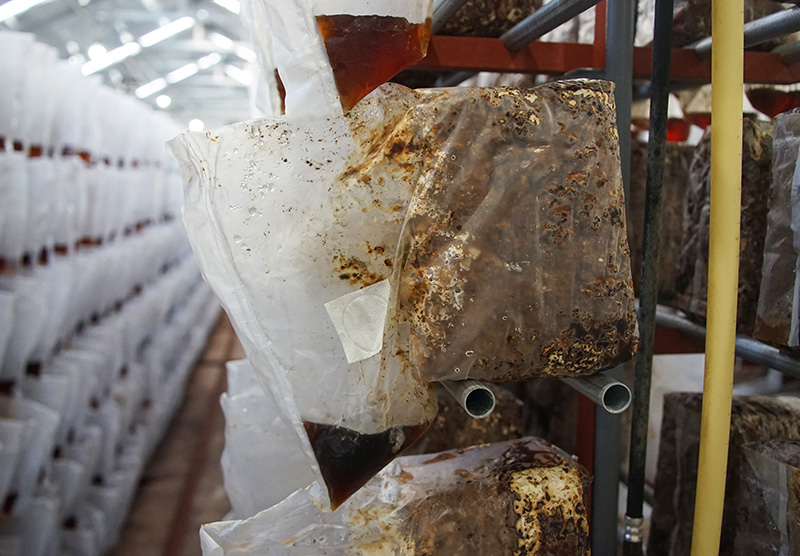
- A block undergoing second stage incubation by one the cooperative farmers. In total, blocks are incubated for 120 days.
- Leveraging cooperation and competitionHow does such a cooperative structure work in practice? And where exactly do the benefits lie? Putting these questions to Mr. Komagata and Mr. Katō, they were keen to point out that one big benefit came simply from their size. By virtue of having multiple producers under one roof, the size of the cooperative makes for more efficient production, and easier investment. In particularly, expansions in terms of automation have been possible simply because they had the means to invest, and the volume to make the labour-saving technology worth it.It is not only size, however, but a flexibility borne in the division of labour between the different sections of the operation that allows for a best of both worlds approach. On the one hand, Mr. Komagata talked about the ways in which the production of blocks is standardised: all the producers use the same blocks, and one of two different shiitake strains; most producers work in the same polytunnels leased by Japan Agriculture, which allows for easy integration between the initial filling and incubation, and delivery (taken on by a separate delivery company, actually delivering the blocks onto shelves directly); and set standards for the harvested mushrooms themselves, headed to market. This allows for scalability, that keeps costs down and ensures consistency for the consumer.On the other hand, there is a surprising amount of leeway left in the process, particularly for the farmers. Having such a complex organisation, would suggest that the only way to make it work would be to have set growing plans for all producers in the cooperative. Putting this to Mr. Komagata, however, he smiled before stating that in fact, it was the opposite. Producers are free to make their own adjustments, and work out what is best for them, to get the best harvest quantity, mushroom quality, and to work around the particularly constraints related to labour etc. This diversity can, as Mr. Komagata was keen to point out, actually turn out to be a strength for the organisation. With the supermarkets Yairo Shiitake supplied, for example, it is important to ensure a steady output and not miss production targets; while there may be fluctuations in supply amongst individual producers, when taken as a whole (and with a three-day stock they always kept on hand), the peaks and troughs even out to allow a steady supply.
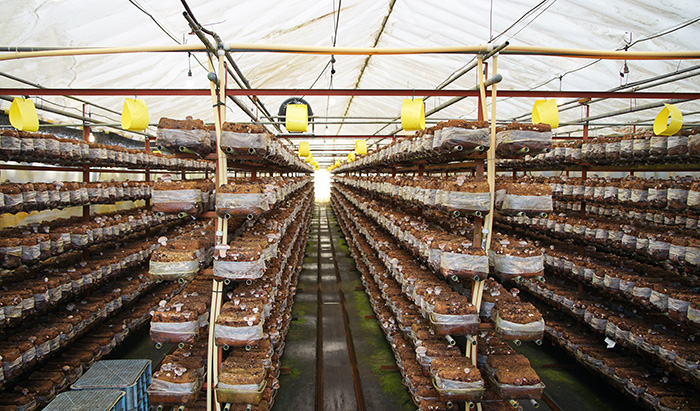
- The neatly organised fruiting rooms of one producer. These rooms are cooled entirely using water from the local surroundings, saving on cooling costs.
- This difference introduces an interesting element of competition between the 11 farmers comprising the cooperative. Both Mr. Komagata and Mr. Katō laughed as they talked about the friendly competition that existed between the different producers, trying to maximise not only yield over the seven or more flushes, but the highest grade mushrooms at the same time. Results showing the highest and best quality farmers are published monthly, providing transparency about relative successes. This competition is then complemented with mutual help, advice, and training amongst growers about tips, tricks, and best practices, leading to constant sharing of information and improvement. The over 60% bioefficiency for the best growers in the cooperative seems to be a testament to the results of this positive tension between competition and cooperation, leveraging the benefits of both market share and collective expertise, whilst leaving room for a little experimentation and rivalry.Building a brand
It is precisely because of the division of labour that this flexibility is possible, farmers not having to worry about the details of substrate mixes, or how or who to market their produce to. This flexibility is also evident in the cooperative management activities as well. `Bookmarking` the whole process, with pre-fruiting block production and post-harvest sorting and packing, Yairo Shiitake management has taken a particularly strong approach to marketing, building up a focused brand that cuts through with consumers. As with many other mushroom producers in Japan, Yairo Shiitake has picked out a clear main selling point for their mushrooms in their juicy thickness, demonstrated in the slogan that was plastered on their company vans: `Almost Too Thick!`. Certainly, even within the Japanese market which prides itself on beautifully thick and meaty shiitake, Yairo Shiitake have taken this to the next level, with well-formed and generous caps.A brief look at their website, however, and it is clear that Yairo Shiitake has put plenty of energy into multiple lines of marketing, not relying on a single selling point to shift their product. The cooperative has, for example, gained four different certifications for their mushrooms, relating to issues that are important to their consumers, ranging from the quality and provenance of their substrate (domestically cut Japanese oak), the safety of all parts of their growing process (testing not only base substrate and nutritional supplementation but water as well, e.g. for radiation), and a broad Japan Good Agricultural Practice certification. These are then displayed on their website and packaging, as a way to speak to particular concerns that Japanese consumers have about food safety and provenance, and set their product apart in a crowded market. 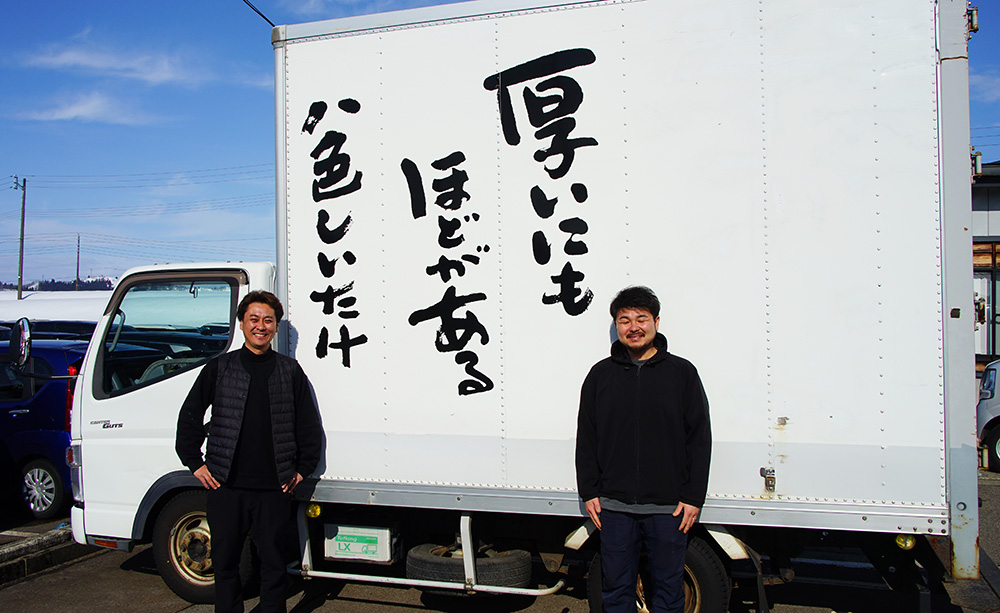
- Managing Director Komata Nagayuki (left) and Deputy Managing Directer Katō Yōhei (right) standing in front of one of the Yairo Shiitake trucks. The slogan plastered on the side says: `Almost Too Thick!`.
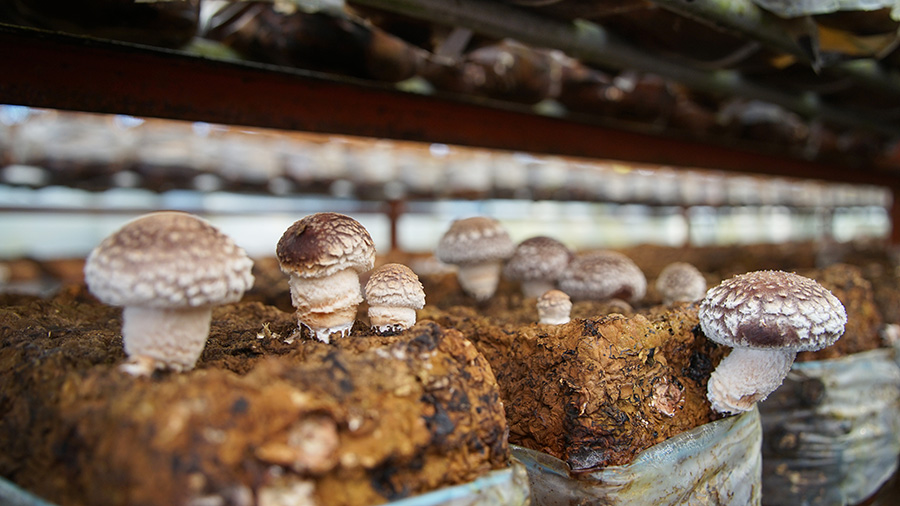
- The beautifully thick shiitake from Yairo Shiitake. Fruiting is controlled by only removing the bag halfway down the block.
- One particularly interesting certification that caught this editor`s eye was a carbon offset project of which Yairo Shiitake was a part. While carbon emissions are not often discussed in the mushroom industry, Mr. Komagata explained how this project was a good alignment for them, and not only in terms of offsetting the emissions as part of their operations. The particular credits they purchase go towards managing an area of forest on the island of Sado, also in Niigata prefecture, and habitat of the famous Japanese ibis. As Mr. Komagata explained, the `ibis forest` image was helpful, as a well-known image for their consumers, of connecting their mushrooms to the natural environment. This, along with other selling points such as only using certain nutritional supplements grown in the local area, then comes together to build a strong brand for the company.From local context to global model?
This integrated and focused approach to branding seems to be another benefit of the organisational structure of Yairo Shiitake, allowing for each branch of the outfit to focus on what they do best, therefore building strong connections with consumers, markets, and the community. This is not to say that the operation is problem-free: Mr. Komagata spoke about how many producers in the cooperative were struggling to find labour to meet their needs, an upshot of being located in a depopulating and ageing community (like most of rural Japan), and with strong competition for workers from other industries in the area. Given this, it is even more remarkable just how many young, energetic and focused farmers grow and work for Yairo Shiitake, with many in their 20s, 30s, and 40s, a rarity in Japanese agriculture.Touring one of the farms after the interview, this energy and focus was evident in the well-organised fruiting rooms, with absolutely no sign of contamination, andperfectly formed mushrooms appearing out of almost every block. Mr. Katō talked about how they used the abundance of natural cool water in the area to keep their rooms at the correct temperature, not having to use any air conditioning despite the hot summers, a boon to producers who can lower their energy costs, and another quirk of the area that sets it apart.Being able to capitalise on the benefits of the area, and the energy of expertise of those wanting to grow for a living, seems to be part and parcel of how Yairo Shiitake is set up. While sprouting from one particular context, there is no doubt possibilities in the clever and flexible approach to responsibility and risk, and the innovation and iteration that arises in both cooperation and competition, for producers in other areas. With the possibility of market and climate instability always looming, the resilience of this model could be one way forward for enterprising mushroom growersMore information about Yairo Shiitake can be found at their website: https://yairoshiitake.com/


 1-2-13 Honmachi, Komoro city, Nagano prefecture, Japan 384-0026