
Login or Subscribe
You must be logged in to access this content
Subscribe for free access to Japanese Exotic Mushroom Journal and gain insider knowledge on effective cultivation methods for Japanese mushroom species. Elevate your skills with expert tips and innovative technologies to master the art of growing Japanese exotic mushrooms.
◆ Discover exclusive Japanese mushroom cultivation techniques
◆ Learn innovative methods to enhance mushroom quality and yield
◆ Tap into Japan's rich heritage for unique growing insights
◆ Discover exclusive Japanese mushroom cultivation techniques
◆ Learn innovative methods to enhance mushroom quality and yield
◆ Tap into Japan's rich heritage for unique growing insights
Subscribe Now for Free Login
Meet the Growers
Shinshu Kinoko Oukoku - One small family farm with a long history
- Series OverviewThe “Meet the Growers” series is one of the centerpieces of the Japanese Exotic Mushroom Journal. In order to provide relevant content to farms that was also relatable, we set out to make a series that traveled across Japan to profile all different kinds of farms. This time, we visited Shinshu Kinoko Oukoku, a small family farm with an over 70-year history tucked away in the foothills of Chikuma City, Nagano Prefecture. We met the third-generation owner, Mikiyoshi Kanai, and toured the three separate facilities where they grow not one, not two, but five species of mushrooms. Shinshu Kinoko Oukoku paired deep technical knowledge with business savvy that has enabled them to succeed in the tough Japanese market. Along the way we heard about many common issues: lack of labor, aging facilities, and rising material costs, which have impacted farms across Japan and the world.
Introduction
I first encountered Shinshu Kinoko Oukoku at a roadside station and fresh produce market in Aoki Village, Nagano, where I happened upon their pink and yellow oyster mushrooms in the mushroom section. Both of these varieties are very rare in Japan, pink oysters exceptionally so. What really caught my attention though, was when I got home and had a chance to sauté the pink and yellow oysters into a simple spinach and mushroom carbonara.I had never actually had the opportunity to eat pink oyster mushrooms; I’d never even seen them for sale in Japan. However, North American clients and responses to posts on the journal’s Instagram had emphasized two points: 1) the moment you heat pink oyster mushrooms they turn brown, and 2) the stem is completely inedible while the overall texture is fairly tough and the taste quite bitter. That’s being generous in my description; one person told me that pink oysters tasted like used socks.I was, therefore, prepared for a bad carbonara, when, to my surprise, the pink oysters retained most of their color, looking like pink strips of salmon in my carbonara sauce, and then, when I ate them, were fairly soft. The stems were not like rubber, and there was no bitterness, but on the contrary, both oyster mushrooms complimented the carbonara sauce wonderfully, adding a nice umami and a mussel-like texture. I immediately wanted to get to the bottom of why these pink oyster mushrooms were so different from the pink oyster mushrooms many Western growers have described to me.A few emails, phone calls later, and I was parked outside of Shinshu Kinoko Oukoku on a truly gorgeous spring day, with a warm breeze flowing down from Mt. Hijiri and into the rustic and agricultural Sarashina area of Chikuma City. A two-story warehouse of corrugated steel, pressed right against a sloping country road marked the original mushroom growing facilities and office of Shinshu Kinoko Oukoku. Only a tiny sign hung up high on a lamppost announced the company’s name, such that I almost missed it even using a navigation app. 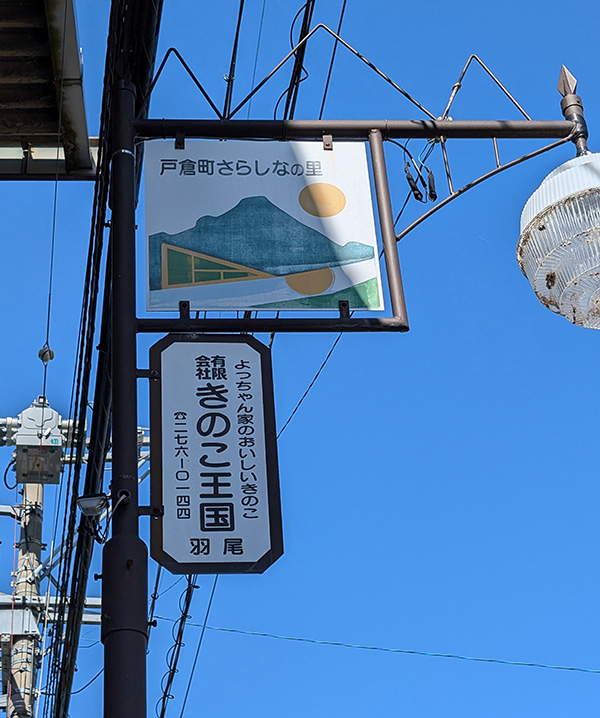
- It was interesting to see the farm`s original sign
Talking about mushrooms and farming in Japan
I first met with Mikiyoshi Kanai, the thirdgeneration owner of this family business, in a small office on the second floor, a smorgasbord of different fresh mushrooms and one pack of dried mushrooms designed for mushroom rice atop the table between us. Mr. Kanai is one of the most welcoming and gracious hosts I’ve come across, as excited to show us around as we were to be there. The two of us spoke equally fast, jumping between topics and points of interest before going to tour the production facilities themselves.The farm has its origins in Mr. Kanai’s grandfather, who in 1957 begin experimenting with growing enoki. This was right around the time that the technology and artificial cultivation techniques for enoki first emerged, and enoki was not yet a year-round crop but a wintertime specialty product. In the Kanai family’s case, their family were rice millers, who milled and distributed rice, and Mr. Kanai’s grandfather originally drifted to enoki as a way of using the large quantities of rice bran that was left over as a waste-product from milling.It was Mr. Kanai’s father who, in 1969, formally incorporated the enoki farm as a business, by which point the family had shifted from rice milling to mushroom farming. This long family history of mushroom farming is unique to Nagano Prefecture, which is where most of the earliest breakthroughs in the artificial cultivation of mushrooms - which first came about through bottle-systems - occurred.Around this point in our conversation, I brought in by way of an aside that I was also struck by the company’s older website design. I could tell that Shinshu Kinoko Oukoku had set up the website in the early 2000s by the design set up, which was remarkably rare for any mushroom farm, even large producers, at that time, much less a smaller, family venture. Mr. Kanai laughed and apologized for the website’s limited functionality; he’d built it himself, he told me, right around the time he first joined the family business. He noted that he wanted to make a new one at some point, but was just too busy.Too busy is the common refrain for all mushroom farms, but especially for smaller scale family farms. What makes Shinshu Kinoko Oukoku unique in this segment of the Japanese market, is that they grow a wide range of mushroom species, handling the entire process from substrate production, filling, incubation, fruiting, and then packaging. Many smaller family farms purchase either premixed substrate or buy already inoculated substrate from incubation centers, but Mr. Kanai made it a point of pride that, starting with his father, their farm had spent years researching substrate and developing their own specialized cultivation techniques.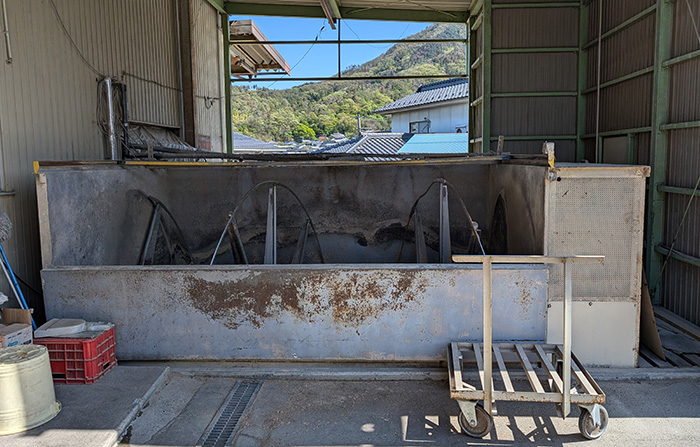
- The mixer is partly set into the ground, which makes for easier loading
- Indeed, Mr. Kanai lamented that the problem with the Japanese JA co-op and other distributors in the mushroom sector is that the moment you sell through them, you have to produce their strains and to their specifications. Everything is then dumped together and sold under one label, which he decried as a big disincentive; a farm like his that spent decades developing its own substrate recipe and unique cultivation techniques in order to produce mushrooms of the highest quality possible, cannot sell for a premium nor maintain their brand identity through these distribution networks.This is a common issue throughout the agricultural sector in Japan. The distribution sector in Japan, especially JA co-op, maintain rigid standards for fresh produce, which does provide stability and consistency for consumers, but this system also ultimately gives farmers fewer options for sales and no ability to create their own branded identity. For mushrooms, as an artificially cultivated product for which it is possible to produce at scale with enormous consistency in color, shape, size, consistency and production cost, this issue is even stronger and it has contributed to mushrooms becoming a cheap, generic, mass market consumable in Japan.Shinshu Kinoko Oukoku has instead focused on direct sales at roadside stations and tourist stops, direct sales to restaurants, hospitals, and on occasion school lunches, and direct to consumer sales. For them, growing numerous varieties of mushrooms gives them marketing value, and helps to drive sales, even if their main variety is enoki. Even in the case of enoki, Shinshu Kinoko Oukoku was one of the first growers in Japan to cultivate the brown/golden enoki variety, and the farm still uses an older, legacy strain that they helped to develop.For enoki, Mr. Kanai emphasized his farm’s focus on a good texture and stronger flavor than what he finds in most commercial enoki brands now. The other varieties they grow: yellow oysters, pink oysters, brown oysters, and lion’s mane, all also have their own unique elements. Mr. Kanai emphasized to me an independent spirit of tinkering and self-sufficiency, one that has helped the farm survive even as the number of mushroom farms in Chikuma City dropped from over 70 to possibly under 20 now (Mr. Kanai wasn’t sure of the exact number). Shinshu Kinoko Oukoku grows about 300 tons of mushrooms a year now, of which its two enoki varieties represent between 60~70%, and the rest split between the other four species it grows.
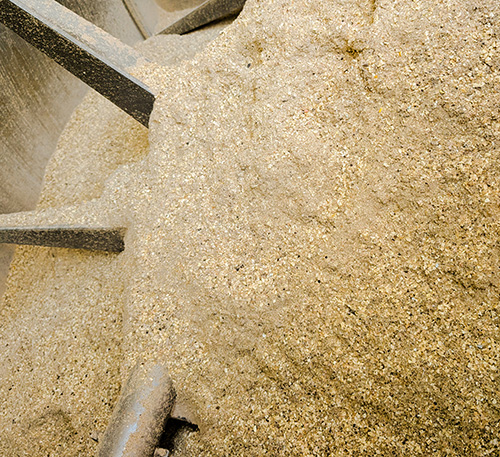
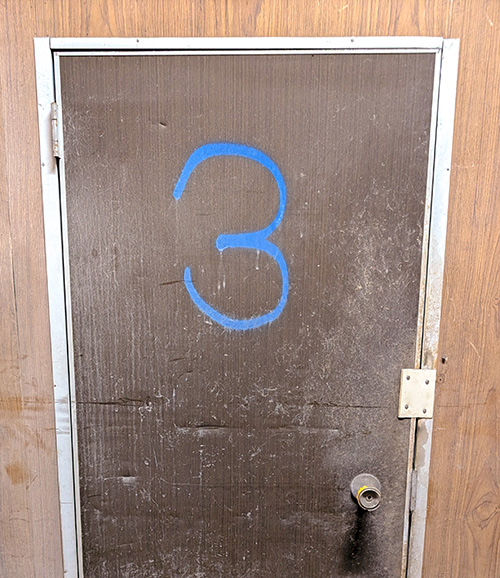 A close-up of the ground corn cob substrate.Plywood paneling on the walls and a wooden door for a retro look.
Visiting the farm facilities
Previously, the farm had produced everything in one location, but as they added new varieties, which had very different cultivation needs than enoki (a cold-climate mushroom), Shinshu Kinoko Oukoku expanded. By buying other, small local farms that went out of business, Shinshu Kinoko Oukoku was able to reuse and preserve those facilities for its own production. Currently, it grows lion’s mane and its three oyster varieties at two separate facilities, each within a few kilometers distance of their original farm (where they grow mostly enoki).
Both secondary facilities were quite interesting to me as very early examples of mushroom farm layout and design in Japan, including the interior plywood-paneling of the walls (insulation foam onto a steel frame and wood panels). Both were very well-used, and had that character that only comes from wear and tear; the very things that serve as evidence for practicality and usefulness.At the very first facility, Mr. Kanai showed us pink and yellow oysters in incubation, and then proceeded to the fruiting rooms. Interestingly enough, even the colonized substrate of the pink oyster mushrooms had a rich, reddish color similar to the red clay soils of the southeastern U.S. For the oyster mushrooms, as with all their cultivated species, Shinshu Kinoko Oukoku uses a ground corncob base, though the rest of the formula varies a bit by variety and is naturally proprietary information.While filling was already finished when we arrived, I like to literally sniff around a new farm. Once you are really used to mushroom farms, there’s a lot you can tell just by the smell. I won’t claim to have the nose of a Michelin-star chef, but I can tell a lot about the freshness and quality of a substrate and a farm’s hygienic practices in a few sniffs. The smell at Shinshu Kinoko Oukoku’s facility was incredibly pleasant. A faintly sweet, popcorn-like smell with elements of bread (presumably from wheat bran and rice bran used as nutrition supplements).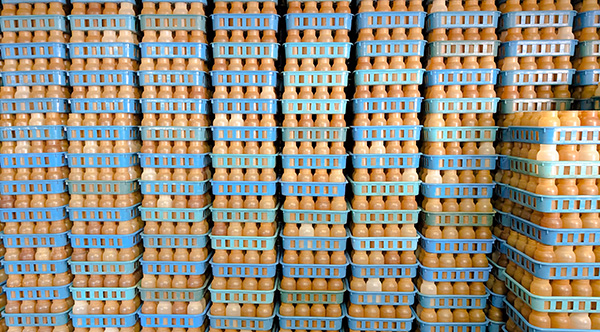
- A wall of empty bottles in trays, prepped for the next day`s filling.
- The farm had a fairly large mixer, around 8 cubic meters (in Japanese terms, this is a 10,000-bottle capacity mixer, and the bottle size it was pegged to was 800ml), set into the ground for ease of access. This facility did all the filling for their other varieties, and Mr. Kanai told me that all the oyster mushroom varieties and even the lion’s mane varieties use pretty much the same substrate mix.Growing oyster mushrooms on a corncob substrate surprised me, even if oyster mushrooms can grow on anything. I pegged this substrate choice as a likely reason why Shinshu Kinoko Oukoku’s pink oysters were moderately sweet and had a light, well-balanced umami flavor, contrary to what I had read from North American readers and farmers. It’s already well established that switching enoki over to corncob from a wood chips/sawdust-based substrate led to sweeter enoki with less bitterness, so it makes sense a similar change over would create better tasting pink oysters.The fruiting rooms showcased, again, to me why bottle cultivation systems are a suboptimal fit for oyster mushroom farming. While the coloration of the pink oysters was absolutely beautiful (and I should mention again that it held up after cooking too), Mr. Kanai told me they can only get between 25~40 grams yield per 800ml bottle. He showed me one sample on the larger end that was about ready to be harvested, and one I thing I noticed here was that they are harvesting pink oysters fairly young. This is likely the reason why the texture was softer and may also explain the lighter flavor. The farm does this because of the shape and size they aim for, but also because the tight space of the bottle neck means that if they wait too long, the mushrooms can grow into each other and become malformed. For the appearance-conscious Japanese consumer this is a cardinal sin, so the farm harvests while the fruiting body is still somewhat immature.The yellow oyster mushrooms were little better, Mr. Kanai explained, as the farm aims for about 70 grams per 800ml, but in reality, gets everything from 50~80 grams per bottle. One issue with the yellow oyster mushrooms was a lack of consistency and height in each cluster. It’s hard for them to get a very evenly developed cluster, so, what happens, for instance, is often that one or two large-stemmed oyster mushrooms will dominate one bottle and the rest will be much smaller and shorter, creating an uneven and inconsistent cluster.The upshot is that the turnover on oyster mushrooms is fast, so they use space efficiently, and oyster mushrooms are fast, aggressive colonizers that rarely have issues with competitor molds and fungi. Therefore, even with aging facilities (which in the case of the second farm that we visited first, used to be a bunashimeji farm, a different mushroom species), they have little issue with contamination.
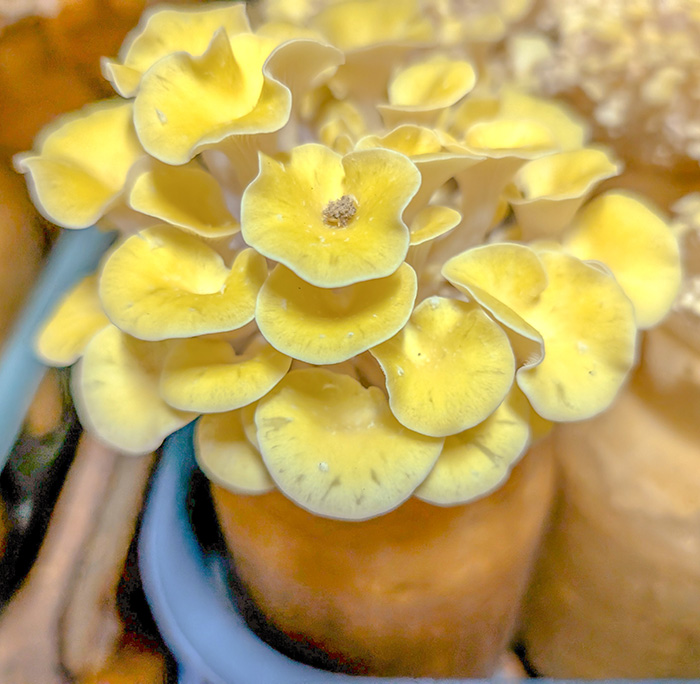
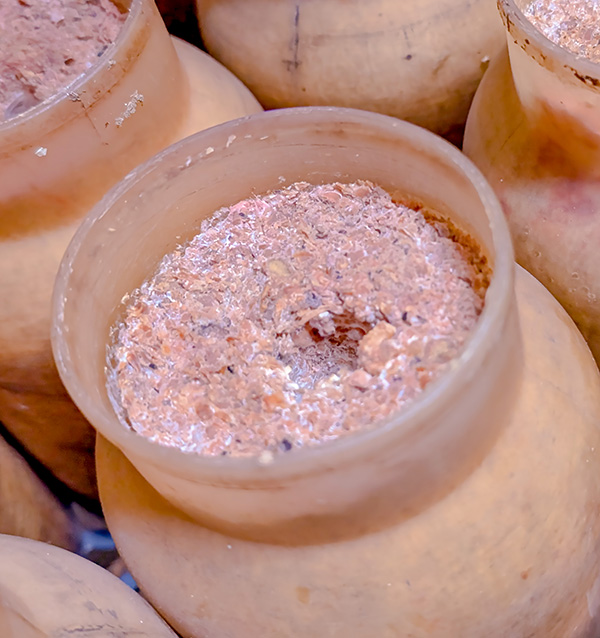 The yellow oysters had a gorgeous coloration.Even the substrate has a pinkish tint.
- The third farm was just above the river bank of the Chikuma River, Japan’s longest river. Because of the location, in summer, the infamous giant centipedes of Japan, as well as common garden snakes, often enter the building. At the third farm we looked at several fruiting rooms and saw incubation rooms as well. On our visit, at the end of April, production had already wound down considerably for the summer months, though it was also, as Mr. Kanai told us, an issue of lacking enough workers to run at a larger capacity.The sunny view of the river and the mountains from the fungal scraping room was a refreshing departure from how closed in and sealed up many farms are. Given the sunny day and clear skies, it added blue and vibrant green contrast to the otherwise gray concrete and brown wooden paneling.
I had my second opportunity to look at lion’s mane mushrooms in a bottle cultivation context. Mr. Kanai deprecatingly described lion’s mane as so easy to grow that it defied the need for cultivation skill. He noted that lion’s mane would grow on pretty much any substrate, had a rapid colonization, and was quite consistent, rarely failing to fruit. The only quirk of lion’s mane in bottle cultivation systems, which I also saw at Kubo Sangyo several years ago, is that it has a tendency to not colonize the entire substrate.Lion’s mane will fully colonize the top third or top half of the substrate, which turns white, but the bottom of the bottle remains brown. The mycelia are, I think, still colonizing this segment of the bottle to some extent, you just cannot tell how much by a simple visual check. Incongruently, this makes lion’s mane substrate in bottles all look like failed incubations, if you approach from the experience of seeing enoki, eryngii, nameko, and bunashimeji cultivation with bottles.The other frustrating quirk of lion’s mane that the owners both Kubo Sangyo and Shinshu Kinoko Oukoku talked to me about, was how lion’s mane would just begin fruiting prematurely before it’d even finished the incubation stage. At Kubo Sangyo, that issue was enough that on occasion the upward force of the fruiting bodies growing within an entire tray would cause the rest of the trays stacked above them to topple over.Mr. Kanai didn’t have that level of issue, but just a quick opening of a few bottles already revealed primordia formation. Lion’s mane, he said, has its own schedule and sometimes the farm has to adjust its pace to match the mushroom. Also like Kubo Sangyo, Mr. Kanai’s farm uses various techniques, (mainly high CO2 saturation), to generate a dense, intricate coral-like lion’s mane that looks quite different from lion’s mane found in both the wild and at Western farms. 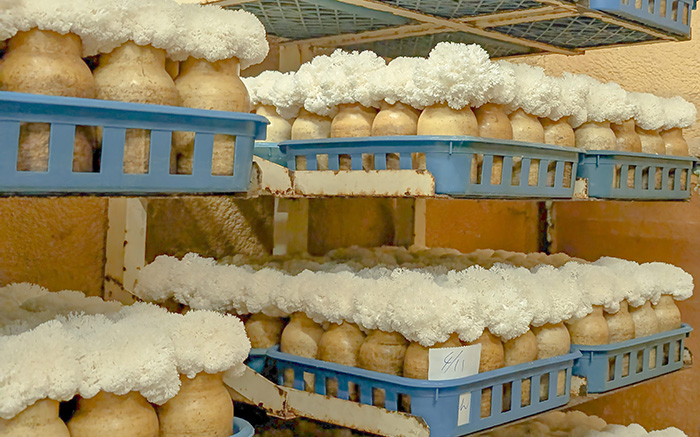
- Several shelves of lion`s mane mushrooms, with distinctive coral structure preferred in Japan.
Back to the main farm
We wrapped up our trip by returning to the main farm and taking a look at the white and brown enoki production at Shinshu Kinoko Oukoku. I was quite impressed with the farm’s hearty yield of roughly 300 grams per 800ml bottle. Perhaps the most surprising thing of the day was Mr. Kanai explaining that the farm, due to small size and also labor constraints, tries to minimize all the moving around of enoki that is standard in Japan. One key element of this is that farm simply doesn’t bother with the narashi phase of cultivation.
The narashi phase of enoki cultivation is a short, transitional phase that begins after pinning and once the enoki have reach a length of 3~5 mm. During the narashi phase, temperatures are lowered from the 14~15-degrees Celsius averages during the pinning stage to between 7~8-degrees Celsius. The narashi phase usually only lasts 2~3 days, and primarily serves to acclimate the enoki to lower temperatures, reducing the shock and stress, and ensuring very consistent, even cluster formation.Shinshu Kinoko Oukoku jumps straight to the yokusei phase, with temperatures lower to 4~5 degrees Celsius. Mr. Kanai laughs that the added stress is exactly what helps to produce the qualities, including an especially crisp texture, that the farm aims for with enoki. He did admit that there is some sacrifice to the consistency among the clusters, but that is also due to CO2 build up in the lower levels and the difficulty of ventilation in their aging facilities (a frozen over humidifier at the top of a backwall as an example). The variation in height was not that bad; I’ve seen even more variation in cluster heights at a similarly old farm that did do the narashi phase; it’s always a matter of enoki clusters on the bottom rows of trays having less oxygen and growing into wide, stump-like clusters that ultimately end up weighing about the same.In any case, the farm’s enoki produced thick, sturdy clusters with a somewhat larger average cap diameter. The most unique trait was that the brown enoki patented by Shinshu Kinoko Oukoku are much less intensely brown/beige in color. The brown enoki have caps close in color to roasted bread, and a light, creamy brown coloration in the stem. I found the caps were also rounder and sturdier looking than other brown enoki varieties that I have encountered in supermarkets and farms before.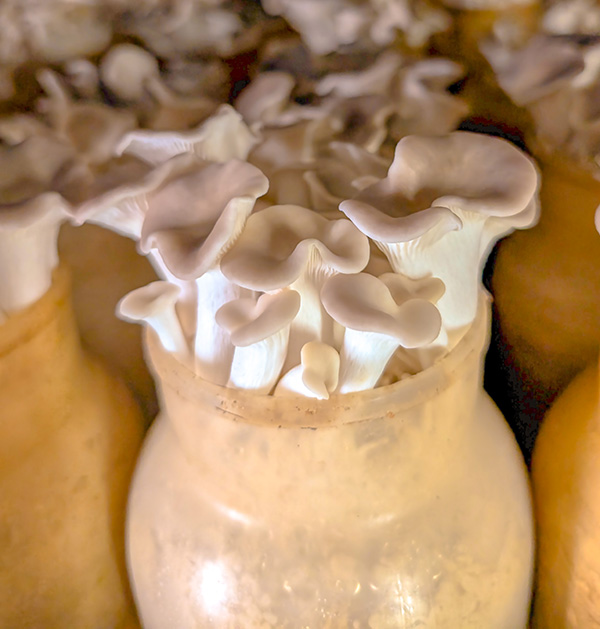
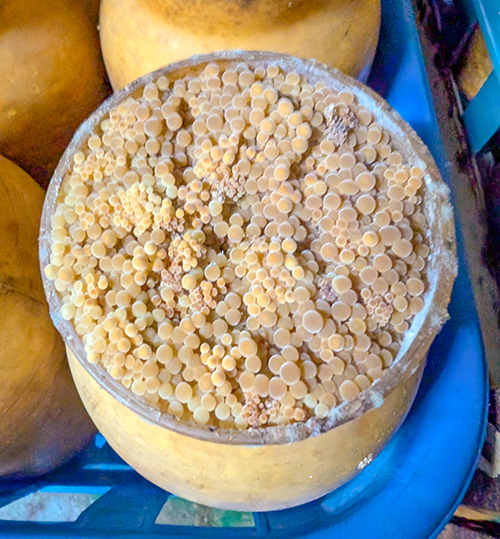 The regular oysters were harvested while still immature.The pinning stage of the brown enoki.
Wrapping up
Towards the end of our trip, we even got to meet Mr. Kanai’s father, the company’s chairman, who cut a diminutive but friendly figure, still at work helping in the packaging room. The Elder Kanai greeted us and asked where we were from, chatting with us for a few minutes before wishing us luck and returning to his own work.After taking a quick tour through the aforementioned enoki fruiting rooms, our tour came to an end. As a souvenir, we received packs of dried mushrooms for takekomi-gohan, which is a Japanese dish wherein fresh rice is cooked together with soy sauce and mirin along with vegetables and/or mushrooms in the rice cooker. Several of the mushroom varieties in the pack came from Shinshu Kinoko Oukoku, as the cutting and packing process always creates unused trimmings. Several other varieties, including shiitake, came from other farms, while the seasoning pack inside was designed by Mr. Kanai and his father according to their tastes. This cook-ready dried vegetable pack is their only long-running venture into in-house branded processed food products.I learned a lot about both the history of mushroom cultivation in Nagano, and the ways in which small family farms have survived a tough business climate. Shinshu Kinoko Oukoku proved to be a small farm with big expertise and a lot of moving pieces. I appreciated Mr. Kanai’s generosity, the thoroughness and openness of his explanations, and enjoyed the chance to look up close at some rare mushroom varieties.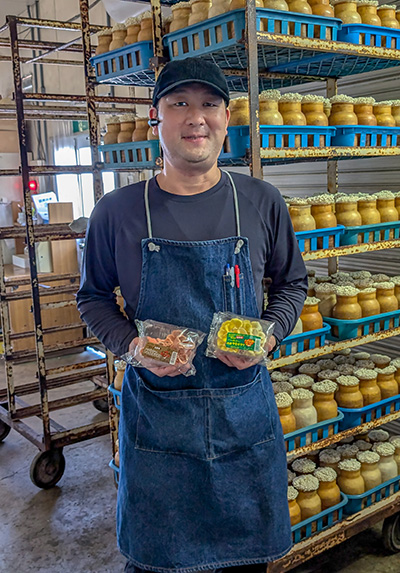
- Mr. Kanai posing with a pack of mushrooms in each hand.


 1-2-13 Honmachi, Komoro city, Nagano prefecture, Japan 384-0026