
Login or Subscribe
You must be logged in to access this content
Subscribe for free access to Japanese Exotic Mushroom Journal and gain insider knowledge on effective cultivation methods for Japanese mushroom species. Elevate your skills with expert tips and innovative technologies to master the art of growing Japanese exotic mushrooms.
◆ Discover exclusive Japanese mushroom cultivation techniques
◆ Learn innovative methods to enhance mushroom quality and yield
◆ Tap into Japan's rich heritage for unique growing insights
◆ Discover exclusive Japanese mushroom cultivation techniques
◆ Learn innovative methods to enhance mushroom quality and yield
◆ Tap into Japan's rich heritage for unique growing insights
Subscribe Now for Free Login
Meet the growers: Oak Farm
Series Overview
Our Meet the growers series remains a key part of the Japanese Exotic Mushroom Journal`s article selection, allowing a glimpse into the varied world of Japanese mushroom cultivation through tours of different farms across the country, showcasing the successes and difficulties that growers of different scales and species deal with. For this edition we visit Oak Farm, a nameko producer in Yamagata, a prefecture in the northern part of Japan, to explore how regionality can still be meaningful even with consistent and scaled-up production.- IntroductionOne interesting aspect of the Japanese mushroom industry has been how, even with standardised growing systems that allow for the growing of different species essentially anywhere (with the correct infrastructure such as cooling and humidification systems), there has been a degree of regional specialisation, with different parts of the country associated with species and connecting it to their local image. For this issue`s `Meet the growers` article the JEMJ decided to visit Oak Farm in Yamagata, a producer of nameko in a prefecture known for the mushroom, to see how links between place and mushroom came to be in the first place, and what meaning they have in the modern mushroom industry.Growing nameko in Yamagata prefecture
Yamagata is well known for its nameko, and is currently in the top three prefectures in terms of production volume, producing over 4000 tons per year, dominated heavily by indoor bottle cultivation, but also with some outdoor log cultivation as well. Of that 4000 tons, around 1400 is produced by one company: Oak Farm. Situated in the north of the prefecture, in the beautiful mountain village of Sakegawa, Oak Farm is part of a strong tradition of mushroom growing in the area; driving up to the farm through the valleys and on a cold November morning in which the first snowfall of the year was still settled on trees and fields, it was impossible to ignore this connection between place and produce, with enoki and maitake farms conspicuous on the otherwise sparse rural roads in the small village of less than 4000 people. .jpg)
- View of the compact but productive Oak Farm facility from the front, with offices, loading bay, sawdust storage, and mixers all neatly laid out on one side.
- Driving up to Oak Farm, however, it was clear that even amongst the many mushrooms grown in the area, nameko is big business: the facility itself was large and well-kept, with a spacious car park and sense of development that almost felt at odds with the half-wild, half-kempt nature of the surroundings. There was also a strong buzz of activity around the farm as I arrived, with lots of movement: large quantities of sawdust being unloaded into a covered storage area giving off a sweet smell, cars driving in and out on errands, and people moving in and out of buildings. Walking into the main offices tacked onto the end of the growing facility, Oak Farm executive director Abe Shingo similarly displayed an energy and confidence as he greeted me, sitting down and not standing on ceremony at all as he immediately mixed curious questions to his interviewer with explanations about his business, and the nameko industry across Japan.Mr. Abe`s family were part of the first wave of indoor nameko producers in the country when they started growing over 50 years ago, making the most of the new technology, and the first in the village to engage in indoor cultivation as opposed to log cultivation which had been a staple of growers in the prefecture up to that point. He spoke broadly and excitedly about these connections between Oak Farm`s development, the history of mushroom growing more generally, and the role of place in it. He ran through a potted history of mushroom cultivation in Mogami district (the broader region of which Sakegawa village is a part, and the centre of Yamagata`s mushroom industry), explaining how there had originally been strong champignon production in the region, making use of rice straw as a base material for the compost. The growing of mushrooms in the agricultural off-season making use of this harvest byproduct also provided a preferable alternative for local residents to leaving one`s family for the winter and heading down to Tokyo to earn money as a migrant worker. With the development of bottle production of enoki in Nagano in the middle of the 20th century this also spread to Yamagata, where local producers made use of glass bottles to grow their own and eventually, with the pioneering work of producers such as Mr. Abe`s family, creating a foundation for the widespread nameko production that still exists today.
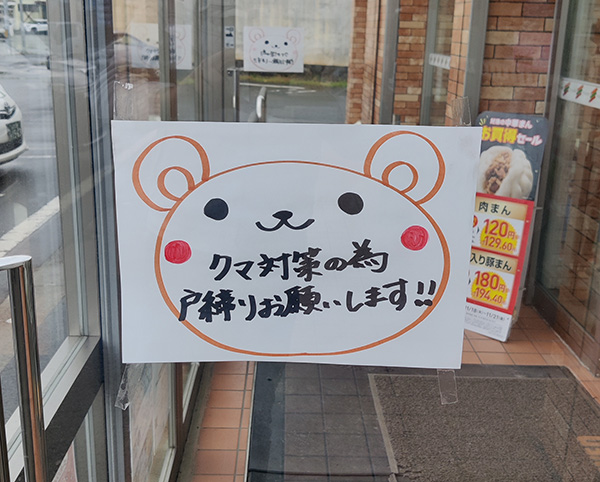 A sign outside a convenience store near to Oak Farm, warning customers to keep the doors closed to prevent bears coming in, pointing to the rurality of northern Yamagata prefecture (as well as Japan`s 2025 bear problem).
- It is somewhat remarkable that this sparsely populated (and depopulating) area of Japan has now become such a central part of the domestic mushroom industry, supplying not only Yamagata, but also markets across the entire eastern half of the country, including the Tokyo metropolitan area. According to Mr. Abe, more than 70% of the prefecture`s mushrooms are grown in this small northern district of Mogami, with a strong presence from nameko but also with producers of maitake, shimeji, enoki, and oyster mushrooms. This is not to say that the region has not changed - it has undergone the same intensification of production as the mushroom industry across the country, with the number of farms decreasing from roughly 30 at its to peak to about 10 now - but the link between place and product still remains strong. When I asked Mr. Abe what it was that made the region so strong in this regard, he paused for a few seconds before saying that at this point, the initial reasons that the industry took root there might not be relevant. After another pause, however, he corrected himself, making a case that the natural environment - clean air and quality water - still counted for something. For water in particular, Mr. Abe proudly explained how they do not use mains water in their cultivation, but instead make use of natural groundwater. Obviously, they take measures to ensure that it is safe to use in production, but this local source of water ensures the highest quality - as Mr. Abe explained, because mushrooms are made up mostly of water, there is no doubt an impact on their produce.Touring the facility
As Mr. Abe showed me around the facility following our initial interview, it was clear that if there is a defining image that connects locality and product, Oak Farm is making it about quality. On the surface, their nameko growing process follows a well-worn and reliable, standardised method for fast-growing, single-flush strains; it is rather in the smaller details that Oak Farm seeks to maintain a good, consistent quality, with some clever and well-thought-out cultivation tricks that allow them to maintain consistency over their large output. 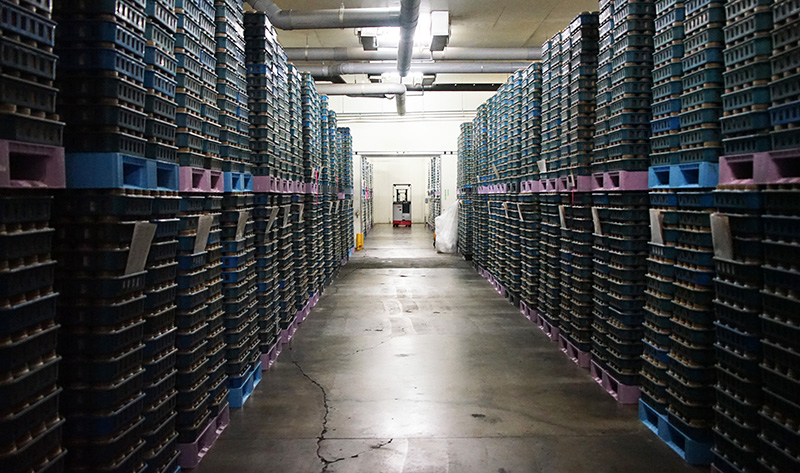
- First stage incubation room with pallets of nameko. Each stack of two pallets represents a unit sterilised in a single autoclave, with all relevant information for that unit noted on the clipboard attached to the pallet.
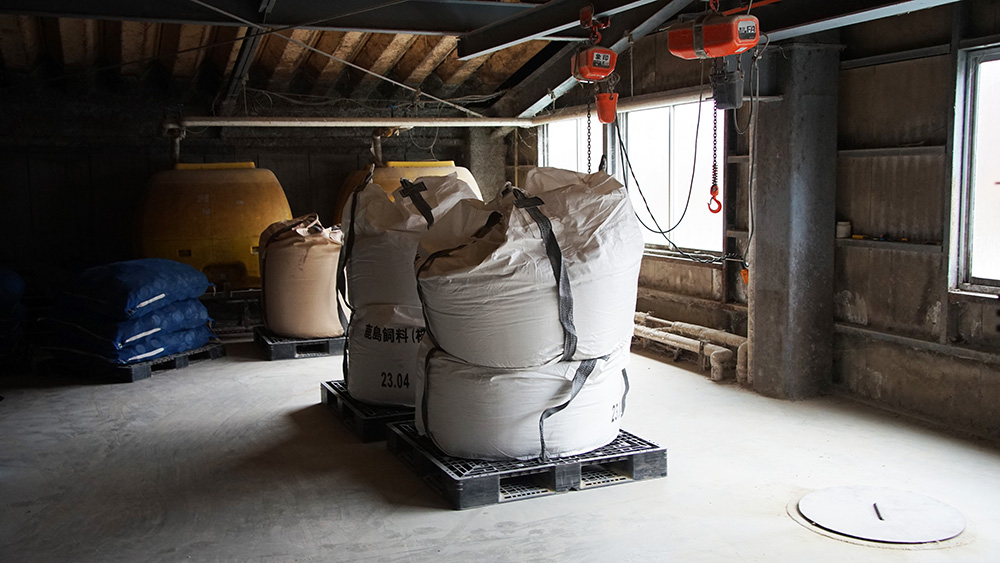
- Nutritional supplement storage located above the mixing and bottling rooms - holes in the floor allow for supplements to be dropped straight into the mixers below.
- The base of their operation is a modern fast-incubating strain which they purchase in as sawdust spawn. The incubation period (split into two _endash_ an initial colonisation stage and then a latter maturing stage) is just two months, with an added few weeks for pinning and fruiting before they are ready for harvest. While many nameko producers work with multiple flushes, Oak Farm harvests just once; this allows them to make use of a smaller, stout bottle specifically designed for the species. Not only does the shorter bottle provide the right amount of substrate for a beautiful single `crown` of nameko (without wasting excess material), but it also allows more crates to be stacked on trolleys for autoclaving, maximising the number of bottles than can be run for each cycle.This fundamental decision is, as Mr. Abe explained to me, not without its reasoning. The larger number of bottles autoclaved (10,000) becomes a neat unit which is used to structure the entirety of their output, streamlining production for the 3 to 5 tons they harvest daily (fluctuating depending on season). The initial autoclaving amount is used as an organising segment that then corresponds to discrete sections in the incubation rooms, and separate rooms entirely for the single fruiting batches. Working in this way allows for simple identification of problems with batches, making it easy to trace issues, whether in a malfunctioning autoclave not reaching temperature, or a poorly ventilated patch in one of the incubation rooms. Each of these batches is followed with a clipboard that has all the relevant information logged onto it - both basic data such as inoculation date and substrate mix to more detailed information such as temperature when evacuated from the autoclave - that allows easy traceability in the event of an issue arising.
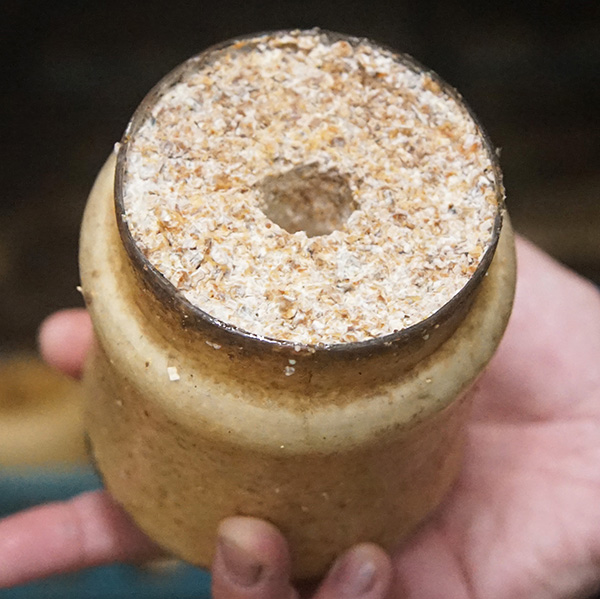
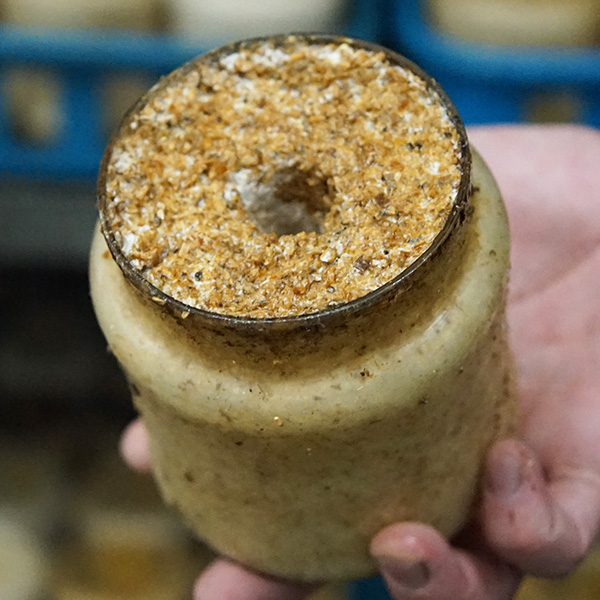
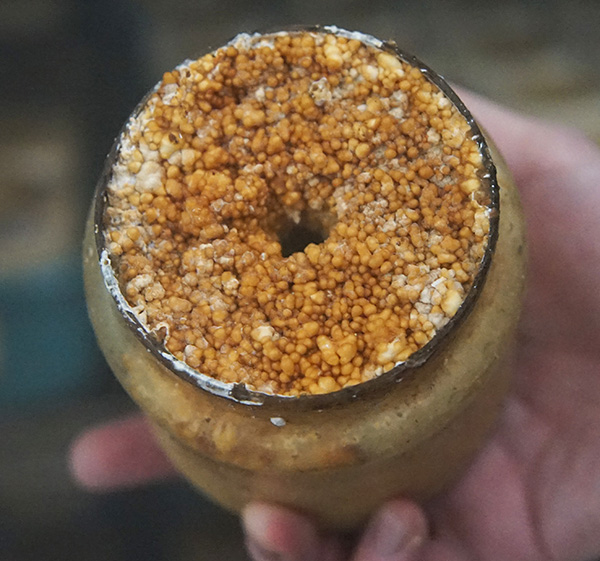 Three different pinning stages for nameko following scraping.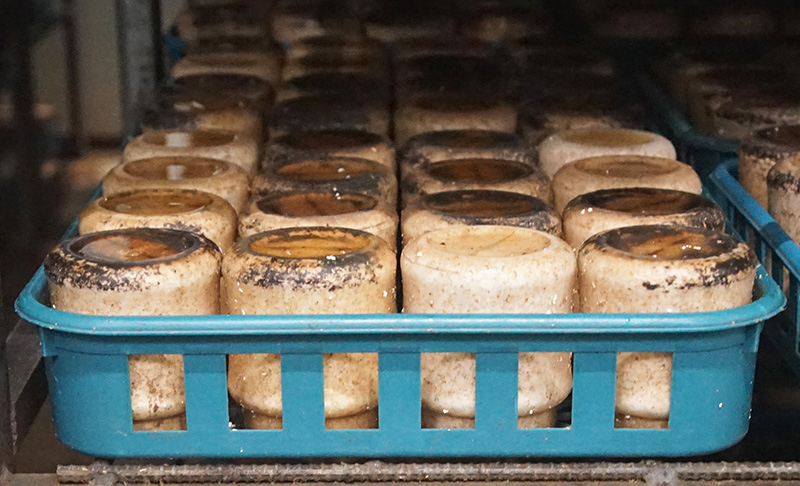
- Bottles placed upside down during the pinning stage. Not only does this reduce contamination but it encourages even growth, and means less attention has to be paid to humidity controls.
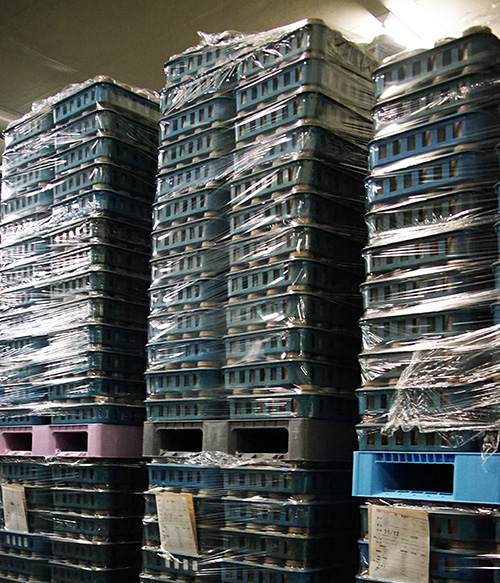 Pallets wrapped in plastic to reduce contamination rates during the first two weeks of incubation following inoculation.
- Walking around the facility with Mr. Abe, I was struck in particular with the neat organisation not only of individual areas but the layout as a whole, with the full cycle of mixing, bottling, autoclaving, inoculation, incubation, scraping, fruiting, and packing laid out into a U-shaped process with wasted movement between different stages cut down to an absolute minimum. Given the large output of the farm, it seemed remarkable that they could manage it in such a compact space, but the use of two floors at the mixing and bottling side for storage, efficient stacking of pallets in incubation, and a loading bay located in between the packing and bottling areas was impressively efficient. No doubt having a single flush helped, but Mr. Abe told me that the entire growing side of the operation (not including harvesting/packing) was run with just five people, making use of a high degree of automation. He was quick to warn me, however, about going too far in that direction, saying that there needed to be a balance between the `hard` efficiency of machine automation and the `soft` interaction and skills of workers who could adapt to the plethora of changes that occurred in growing rooms and needed to be adapted to.The `tricks` that Oak Farm utilised for good uniformity and consistency were simple, but clearly very effective. The initial incubation stage was further split by thefarm into two: for the first two weeks they wrapped each and every pallet in plastic wrap, before being `unwrapped` for the next two weeks. Mr. Abe explained that they did this to reduce contamination as much as possible, by limiting airflow through the bottles; as the mycelium were still just beginning to colonise the substrate there was little air exchange needed, but it was vitally important to reduce the potential for external bacteria or mould to get in. He told me that they knew it was having an effect because of the difference in contamination rates they found between the top layer of bottles (not covered by plastic) and the rest of the pallet.Moving into post-incubation, Oak Farm maintained evenness through a mixture of scraping, and pinning the bottles upside down. It is not strictly necessary to scrape nameko, as they will naturally pin on their own, but as Mr. Abe explained to me, scraping allows for a uniform `shock` across each batch at the same time, meaning that growth from that point onwards will be the same. Following scraping, the bottles are flipped upside down (using a separate machine on the scraping line), before being moved to a high-humidity pinning room. Cultivating bottles upside down is often seen in eryngii growing operations, as a means to stop water from settling on the top of bottles and causing contamination; while this was one reason for Oak Farm`s decision to use it with nameko, Mr. Abe told me it was also about creating much more even growth on the bunch, leading to a neat `bowl-shaped` floret of mushrooms coming out of the top, as opposed to mushrooms with stems of different length. The extra effort required to flip them twice was worth it, for the consistency it provided.
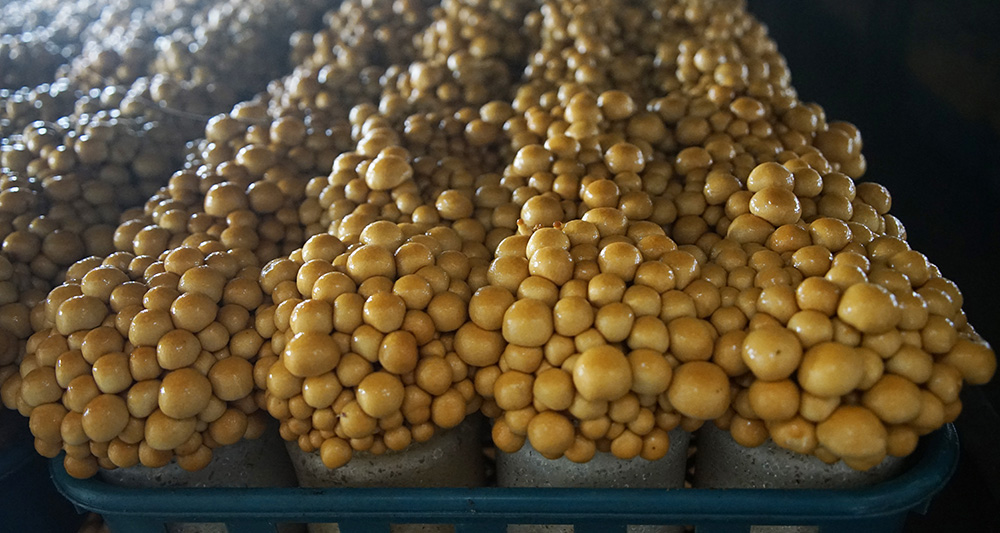
- Beautiful nameko `crowns` ready for harvesting.
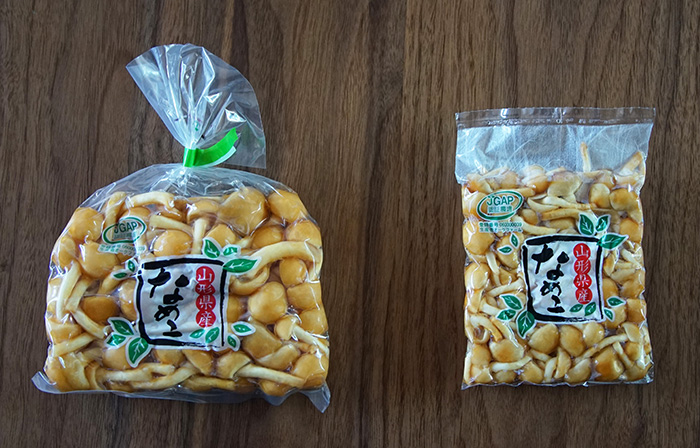
- The two pack sizes which Oak Farm produces - on the left, 150g of larger mushrooms destined for the Tohoku market east of Tokyo; on the right, 100g of smaller mushrooms headed to Tokyo. Oak Farm grades their mushrooms into these two sizes only, a split partly based on regional consumer preference.
- The importance of regionalityHow, then, is this dedication to quality and consistency connected to regionality? In Japan, there is already a strong market for making connections between place and produce/product, with different cities, local areas, or prefectures becoming associated with sweets, activities, and agricultural goods. This is partly connected to domestic tourism, allowing visitors to visualise what an area is famous for, where to visit when there, and what gifts to buy for friends, families, and colleagues before coming home. Even in day-to-day consumer activity, however, it has an impact, as a marker of quality and trust, as people know to buy certain types of produce grown in particular areas of the country.The extent to which mushrooms can be connected to specific localities in the minds of consumers, however, is less clear. On the one hand, most consumers in Japan see mushrooms as a cheap staple that finds its way into the shopping basket regardless of region and purchasing choices are made predominately based on price. On the other hand, there are plenty of examples of producer groups or local government trying to make links between quality produce and particular areas. Yamagata prefecture has, for example, pages on their `Flavor of Yamagata` tourism-oriented website dedicated to nameko growing, and emphasising the quality of the prefecture`s produce. Yamagata also holds a particular image within the collective understanding of localities as a mountainous, rural region, an image which aligns strongly with mushroom growing (even if functionally meaningless in terms of the actual growing conditions).Visiting Oak Farm gave me a sense of the ways in which regionality and distinctiveness do still factor into mushroom production, at least in terms of the decisions that are made by producers. It was evident, for example, in the packaging of Oak Farm mushrooms, which clearly use Yamagata as a selling point, writing the name of the prefecture on the front of the pack next to the name of the mushroom itself. Oak Farm also makes a point on their website of highlighting the natural environment of Sakegawa village through its clean air and water, as well as the fact that their beech and oak sawdust is also sourced from Yamagata or the neighbouring prefecture of Akita.While this connection to regionality is partly about `selling` an image of where mushrooms are produced, it also involves understanding the regionality of the markets being shipped to. It was fascinating to hear Mr. Abe talk about how their two sizes of nameko - smaller `baby` nameko with a lighter colour and more closed caps, and a larger size with a deeper orange colour and more open caps - were actually destined for entirely different domestic markets. While Tokyo prefer their nameko small, apparently the broad region of Tohoku - including some large metropolitan areas but in general fairly rural - like their mushrooms larger and more obviously `mushroom-like`. Mr. Abe put this down to a lingering understanding from consumers living closer to the mountains of what mushrooms look like in the wild, and therefore a link to the original non-domesticated strains from which all cultivated fungi come from.These two aspects of regionality - producer- and consumer-based - show the possibilities of paying attention to location, as a means to create differentiation even with growing systems that market themselves in terms of uniformity, growing the same product, all year round, and in any location (though interestingly, Mr. Abe did half-jokingly wonder about whether anthropogenic climate change would make it impossible to keep air-conditioning units functioning properly in some locations). Perhaps this links to Mr. Abe`s words of wisdom about the balance between the `hard` and the `soft` in mushroom growing: enough rigidity in production to keep up a consistent, efficient, and quality supply, whilst also enough flexibility (and curiosity and imagination) to think about all those connections that sustain the farm outside of it, to physical surroundings, and to consumers in other locations. In this respect, Oak Farm have got the balance just right, from mountainous rurality, to people`s plates in the city.More information about Oak Farm can be found at: http://www.oakfarm.or.jp/index.html
The `Flavor of Yamagata` tourism website can be found at: https://www.yamagata.nmai.org/english/index.html


 1-2-13 Honmachi, Komoro city, Nagano prefecture, Japan 384-0026