

Login or Subscribe
You must be logged in to access this content
Subscribe for free access to Japanese Exotic Mushroom Journal and gain insider knowledge on effective cultivation methods for Japanese mushroom species. Elevate your skills with expert tips and innovative technologies to master the art of growing Japanese exotic mushrooms.
◆ Discover exclusive Japanese mushroom cultivation techniques
◆ Learn innovative methods to enhance mushroom quality and yield
◆ Tap into Japan's rich heritage for unique growing insights
◆ Discover exclusive Japanese mushroom cultivation techniques
◆ Learn innovative methods to enhance mushroom quality and yield
◆ Tap into Japan's rich heritage for unique growing insights
Subscribe Now for Free Login
Meet the growers: Hōshuyama Kinoko
Series Overview
Our `Meet the growers` series remains a key part of the Japanese Exotic Mushroom Journal`s article selection, allowing a glimpse into the varied world of Japanese mushroom cultivation through tours of different farms across the country, showcasing the successes and difficulties that growers of different scales and species deal with. For this edition we visit Hōshuyama Kinoko, a shiitake grower on the southern Japanese island of Kyushu, to examine how multiple generations of the same family have continued the cultivation tradition against a backdrop of instability.
- A sign on one of the Hōshuyama Kinoko buildings, pointing people towards a shop where mushrooms can be purchased directly from the grower.
- Introduction
How do you manage longevity in business, over multiple generations, in an unstable or even shrinking market? And what are the qualities in a mushroom farmer that contribute to a thriving, long-lasting business? This edition`s Meet the growers keeps these questions in mind as we visit a shiitake farmer on the southern island of Kyushu, looking at how a smaller-scale producer is able to leverage built-up knowledge and community to extend a remarkable growing history.Hōshuyama Kinoko
Nestled in the mountains of Fukuoka prefecture, Hōshuyama Kinoko is a shiitake farm with a long history, even within the mushroom-loving country of Japan. Started close to 100 years ago with the cultivation of shiitake logs, it is still producing the same mushroom, albeit in a slightly different way, with the shift over to block cultivation a few decades ago.The farm itself is located in the small village of Tōhōmura, home to less than 2000 people, up in the mountains close to the border with neighbouring Ōita prefecture. The route up to the farm involved winding through misty mountain roads, with my guide pointing out to me the large amount of landscape development that was being conducted on either side as excavators and trucks seemingly reshaped the mountainside. As he explained to me, this was work that needed to be done after torrential rainfall that caused landslides and widespread damage to the village and surrounding region almost a decade ago (a reminder _endash_ not that one is really needed _endash_ that Japan is never far away from the potential for major environmental upheaval). Whilst impacted by the disaster, and having to stop shipping their shiitake after their growing houses sustained damage, Hōshuyama Kinoko survived amongst the upheaval, continuing its story amongst the instability. 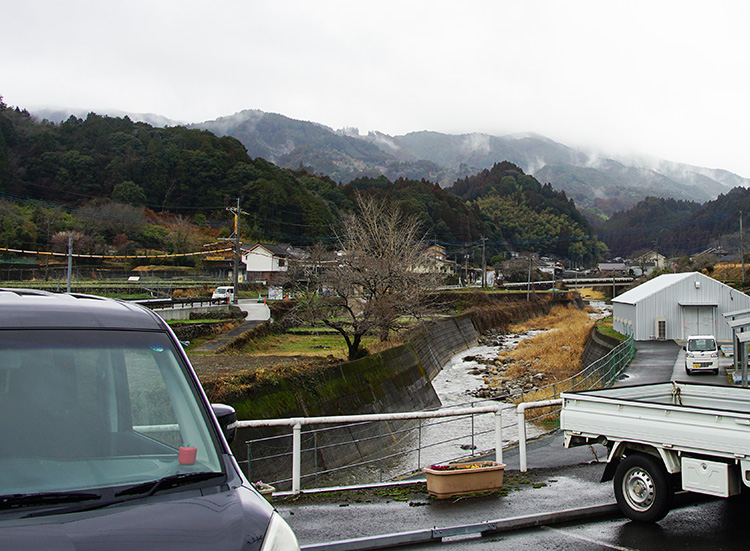
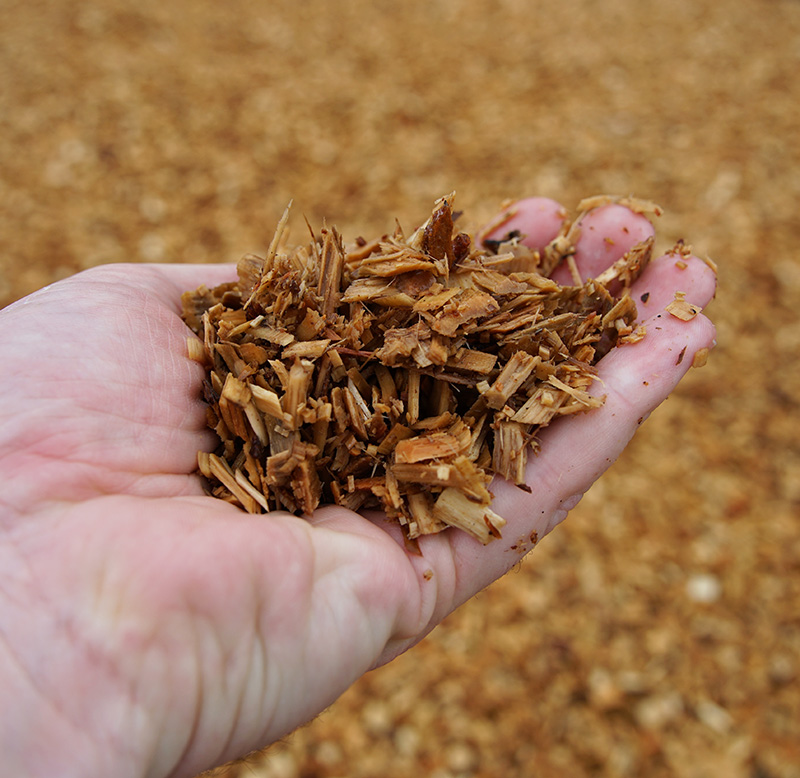 The misty mountains surrounding the village of Tōhōmura, viewed from the farm parking lot, and next to the stream that runs through the village.The coarse sawdust that was used at the farm. The fast turnover of sawdust kept in small piles meant that it being kept uncovered open to the elements was not a problem.
- Arriving at the farm we sat down to talk with the director of Hōshuyama Kinoko, Kawamura Tomoko. Focused and engaged, but with an easy-going and friendly manner, Ms. Kawamura immediately made this editor feel at home as we discussed how she had found her way into the family business. Coming from a family of mushroom growers, her route to becoming the fourth generation to take up the mantle was a circuitous one, via a doctorate in agricultural science, researching agriculture rooted in locality. It was only after doing these years of research that she returned home in 2007, drawing on her research experience and interests to keep the tradition going.Simple, neat growing
Hōshuyama Kinoko sits on the smaller side of shiitake growers in Japan, producing about 90 tons of mushrooms a year (on about 140,000 blocks). Once harvested these head predominately to regional distributors to go to supermarkets, or to the fruit and vegetable market, with only a small amount of the larger, prime specimens being sent, four times a week, to Tokyo for a better price. This mix of customers is common in Japan, as a means to both deal in quantity, and get maximum value for the best quality mushrooms.Having renewed their farm buildings about 10 years ago, Hōshuyama Kinoko has a very slick, clean growing operation, spread across a small number of unassuming grey growing rooms. Making use of a coarser sawdust than is often found at shiitake growers (very coarse material is often utilised for multiple flushes, but here they limit to two harvests), mixing, filling, inoculation, and incubation are run according to standard practices, but with clear attention paid to keeping things neat and organised, with an understanding of how workers, trolleys, and materials move around the farm. 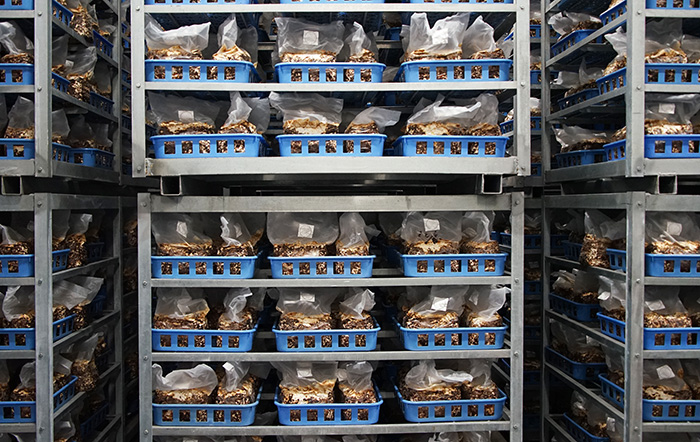
- An impressively neat incubation room, with mushrooms coming to the end of the browning stage. There was no contamination obvious at any of the incubation stages, a testament to a well managed growing process.
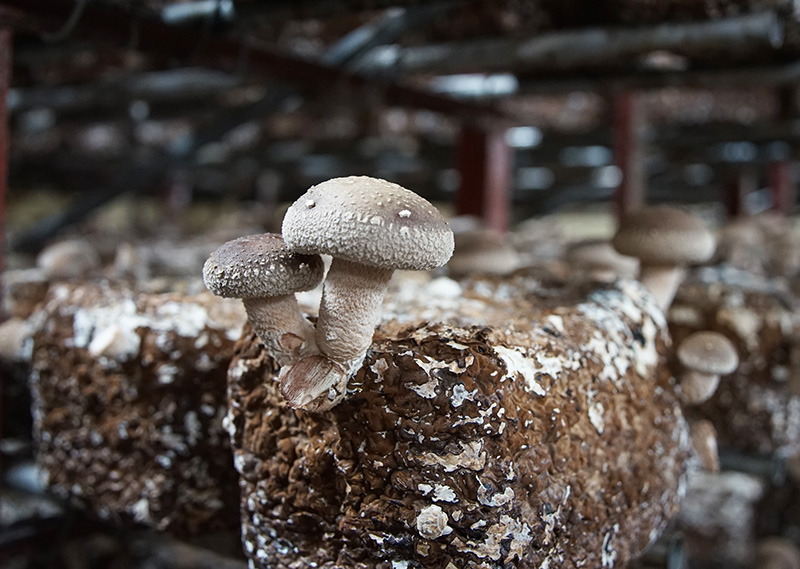
- The shiitake at the farm had many of the hallmarks of the best quality found in Japan: good-sized with thick stems and caps, lightly-coloured, and picked not too late to preserve a pleasing shape and prevent lost weight.
- One noticeable outlying practice was the cutting, as opposed to pulling by hand, of shiitake fruit from the block. While cutting is often common outside of Japan as a quick method to work through a fruited block, in general in Japan hand-plucking is utilised because of the ability to maintain a long stem, and neatly trim it up at a later stage before packing. Skilled harvesters, however, were able to cut the mushrooms with enough stem remaining at the harvesting stage, saving time by not needing to trim later on. The flipside of this, is then needing to do a brief neatening up of the blocks before soaking them in between flushes.Hōshuyama Kinoko still has its fair share of challenges, particularly with depressed prices for shiitake more broadly, partly the result of imported mushrooms and blocks from China (while there has been improvement through strengthened regulation on the import of blocks into the country, this still remains an issue). As Ms. Kawamura explained, there was no way they could compete on price; as such the farm has worked to develop a brand for itself (as with other producers we have seen in this series) that can put a bit of distance between a higher quality Hōshuyama mushroom and an imported one.
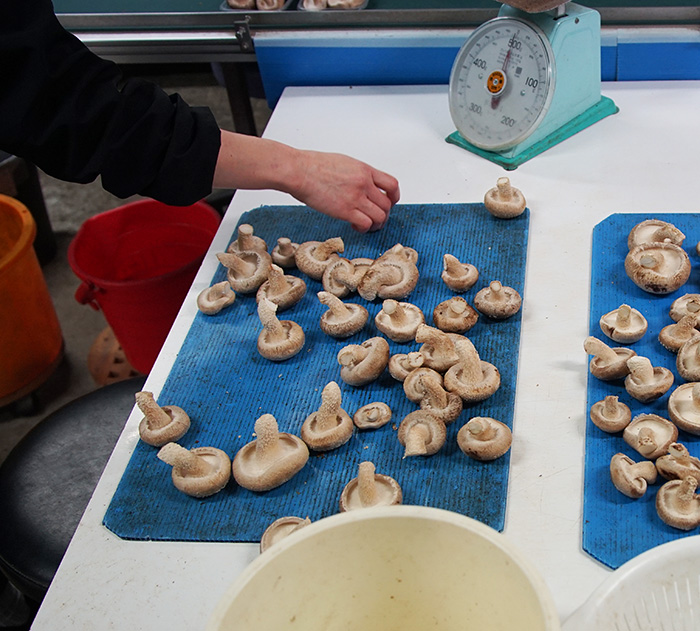 A worker sorting and packing mushrooms by hand. While they are considering automation for this stage, at the moment they rely on the hard work of local employees.
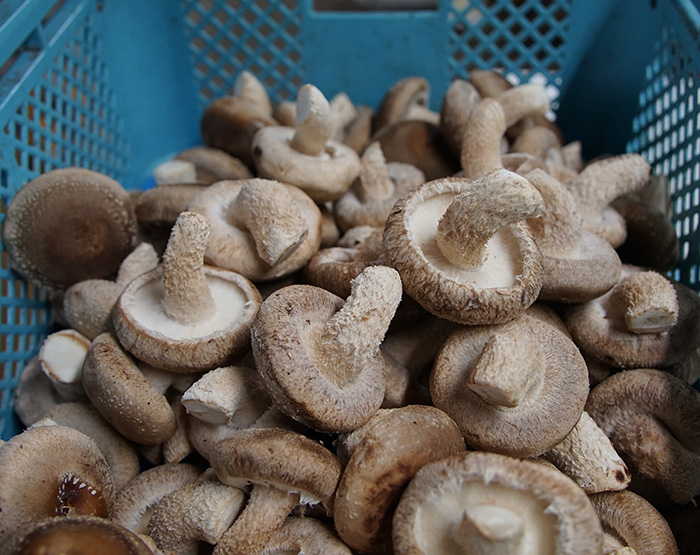 The beautiful shiitake harvested at the farm. As is the preference in Japan, these are harvested while still with the caps curled inwards.
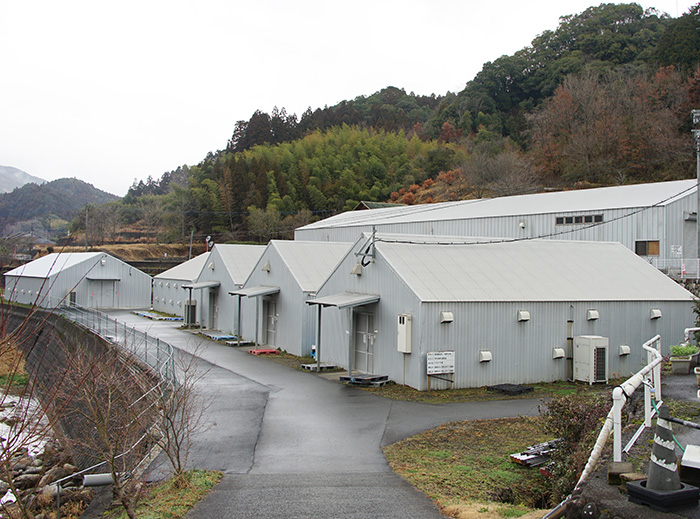 A view of the farm buildings. Whilst taking damage after extremely heavy rainfall a number of years ago, operations soon resumed.
- One other issue that the farm faces _endash_ again, a common one _endash_ is sourcing the labour required to grow, harvest, and pack their shiitake. Whilst there is some degree of automation in their growing _endash_ relying on standard machinery for mixing, bagging, sterilisation, and inoculation _endash_ the harvesting is done by hand, as is sorting and packing. Such labour issues are a given, as Ms. Kawamura explained, in a rural village such as they one they are located in, where depopulation shows now sign of abating, and the average age is high. It was partly because of these workforce issues that they had to reduce the number of flushes from two to three, to cut down some of the labour-intensive harvesting work.Community-driven growing amongst instability
Given some of the essential instability that underpins their growing operation _endash_ in environment, market, and labour _endash_ touring the farm it was notable how cohesive and community-driven the operation felt. The philosophy (or rather, practice) of locally-rooted mushroom growing was clearly evident as we walked around, with older workers laughing jovially to each other as they worked sorting and packing, and greeting Ms. Kawamura as we walked around. 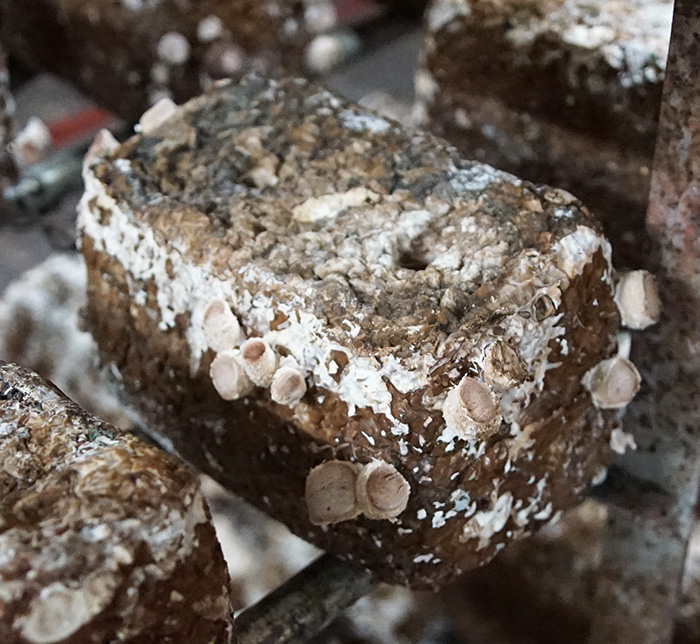
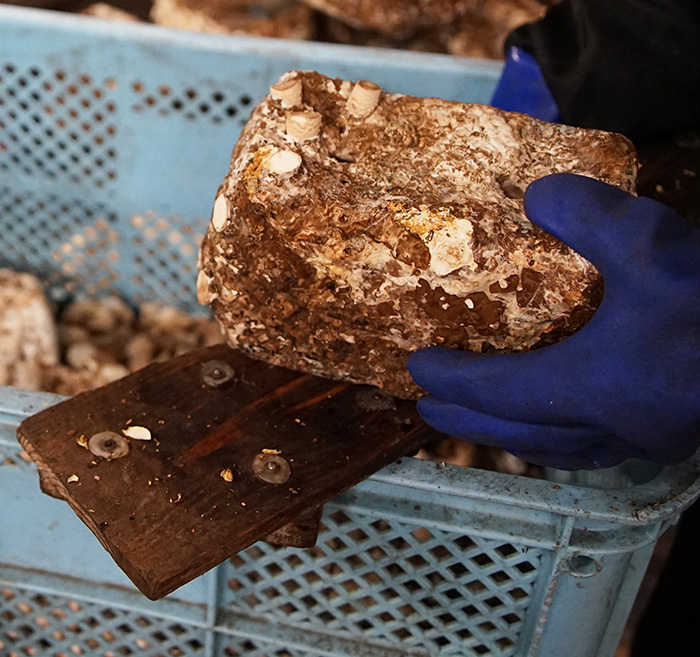 Left: A block after harvesting with a knife, with stumps remaining. Right: The process of cleaning up each block, before soaking ready for the subsequent flush.
- During our initial interview Ms. Kawamura was sure to spell out the importance of community relations within such a small, close-knit village, and as a farm with such a long history. In total, Hōshuyama Kinoko employed around 15 workers, but with only 10 or 11 working on a given day, and each employee getting 2 days off a week. In general, Ms. Kawamura emphasised the importance of flexibility in terms of working, especially with a predominately older workforce; she joked that the older workers would make their opinions known if they were kept too long, and liked to head to bed early. Rather than being an impediment to a smooth growing operation, however, Ms. Kawamura took these quirks in her stride, laughing affectionately.Ultimately, Hōshuyama Kinoko is an excellent example of how rootedness and longevity has maintained in mushroom growing in Japan, not only through attention to detail in the cultivation process, but also the cultivation of the various connections and community that allow for survival even amongst instability. No doubt these fundamentals will allow Ms. Kawamura and co to thrive for many decades more.For more information about Hōshuyama Kinoko, visit: https://kinokokumiai.or.jp/
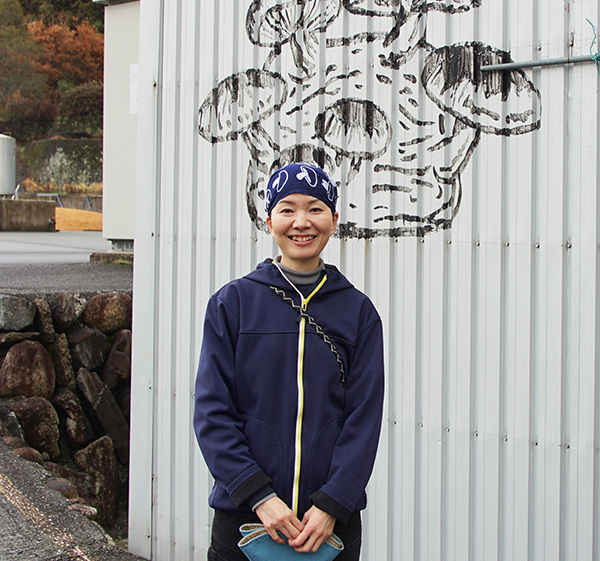
- The director of Hōshuyama Kinoko, Kawamura Tomoko, in front of an mushroom illustration. Ms. Kawamura has utilised her research background to continue the long tradition of mushroom growing started three generations prior.


 1-2-13 Honmachi, Komoro city, Nagano prefecture, Japan 384-0026