

Login or Subscribe
You must be logged in to access this content
Subscribe for free access to Japanese Exotic Mushroom Journal and gain insider knowledge on effective cultivation methods for Japanese mushroom species. Elevate your skills with expert tips and innovative technologies to master the art of growing Japanese exotic mushrooms.
◆ Discover exclusive Japanese mushroom cultivation techniques
◆ Learn innovative methods to enhance mushroom quality and yield
◆ Tap into Japan's rich heritage for unique growing insights
◆ Discover exclusive Japanese mushroom cultivation techniques
◆ Learn innovative methods to enhance mushroom quality and yield
◆ Tap into Japan's rich heritage for unique growing insights
Subscribe Now for Free Login
Compact facilities for exotic mushroom farming using low- and high-tech methods
Babla Shingha Barua (PhD)Email: drbsbarua@gmail.comAbstract
Exotic mushrooms represent a profitable agribusiness opportunity, addressing several key issues including resource utilization, the circular economy, job creation, sustainability, and nutritional security_emdash_while also helping to mitigate the impacts of unpredictable weather. Although mushroom farming and cultivation are becoming increasingly popular and sophisticated, a crucial aspect of successful mushroom growth is weather monitoring and management, particularly with respect to humidity and temperature.In many rural areas around the world, mushrooms are cultivated using traditional methods. These methods are often labor-intensive and prone to problems, such as the accidental growth of toxic mushrooms due to inadequate monitoring of environmental and cultivation conditions. However, this article discusses exotic mushroom farming in compact facilities, such as handmade straw houses and repurposed shipping containers.Investment and return for beginners
Before making an initial investment, one must first consider the type of farm they wish to establish for mushroom cultivation. If someone wants to start with a compact farming model, the required cost may be relatively low. However, if someone intends to develop a more commercial-scale farm, they must take into account a minimum range of fixed and variable costs.In compact farming, one can begin cultivating mushrooms within their own home, avoiding the issue of land or space limitations. In such cases, a person can cultivate mushrooms independently, eliminating the need for labor and associated labor costs.Land acquisition
To cultivate mushrooms, a designated cultivation room is essential. Building a proper cultivation room begins with securing an adequate area of land or space. If someone already owns land, they do not need to bear additional expenses for acquisition. However, if they do not have their own space, they must acquire a small plot of land.A compact plot for mushroom cultivation should be at least 40 square meters (equivalent to 435.6 square feet). When it comes to acquiring land, there are two options: purchasing the land or leasing it. For a new entrepreneur, leasing the land is generally the more favorable option.Construction of the cultivation room
The standard size of a cultivation room should be at least 67 square meters (roughly 720 square feet), which requires approximately 70 square meters of land. The fencing and roofing of the cultivation room must be constructed with bamboo, meaning the entire room should be built using bamboo. The shelves inside the room, where the mushroom spawn packets will be placed, must be made with high-quality wood. The mushroom substrate should consist of straw, or materials such as bean or rice hulls.Low-tech methods for preparing straw substrate
The size and cut of the straw can significantly affect mushroom cultivation. Long straw may be harder to pasteurize and may not allow the mycelium to spread evenly. For optimal results, it is best to chop or shred the straw into smaller pieces, typically around 5~10 cm (2 to 4 inches) in length. Chopped straw allows for better mycelium colonization and faster substrate breakdown, although chopping is not strictly necessary. Generally, the more uniform the straw size, the better the growing resultsAnother important factor is the freshness of the straw. Mushrooms grow best in substrates that are fresh, as aged or poorly stored straw can introduce molds and other microorganisms that compete for nutrients. It is advisable to use freshly cut straw, or straw that has been stored in a dry environment. Straw exposed to moisture or humidity for extended periods may become moldy, which not only competes with the mushrooms but can also attract pests and disrupt mycelium colonization, leading to lower yields.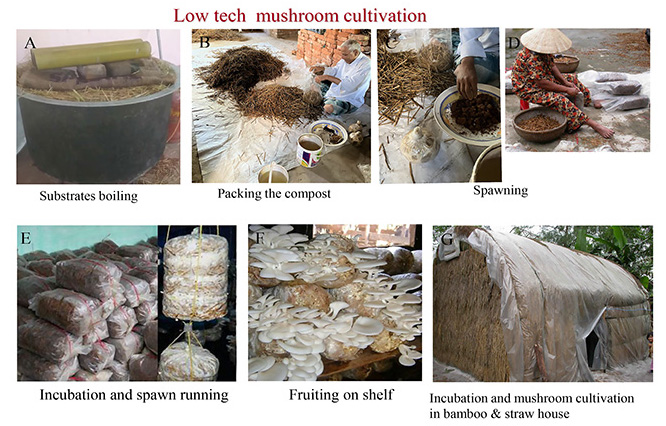
- Figure 1: Exotic mushroom cultivation using low tech facilities (A-G); B & C are of mushroom cultivation at a separate village farm.
Simplest substrate disinfection/sterilization methods
Disinfecting or sterilizing the substrate is essential to eliminate contaminants that could compete with the mushroom mycelium and prevent successful colonization. Without proper sterilization, successful cultivation is unlikely. Two common methods are used for this purpose: boiling pasteurization and lime bath treatment.A) Pasteurization by substrate boiling:Pasteurization does not fully sterilize the substrate but is effective at eliminating unwanted organisms such as nematodes, bacteria, fungi, and other pests, while retaining beneficial microbes. It is a relatively quick and simple process, though it requires a larger amount of water. To perform this method, use a large drum with a 200-liter capacity and a meshed basket to hold the substrate. Place the drum on a burner and ensure it has a pressure regulator. Fill the drum with water and heat it thoroughly. Then place the straw-filled basket into the warm water. It is recommended to place a weight on top of the straw to keep it submerged. Let the straw soak for 1.5 to 2 hours, maintaining a temperature between 85 and 95 degrees Celsius. A thermometer can be used to monitor the temperature.After the soaking period, remove the basket and empty the water from the drum. Let the straw cool for a few hours. Properly drain the straw so that it is only slightly damp. To check, squeeze a handful_emdash_if more than a few drops come out, drain it further. Avoid using the straw while it is still too hot, as mushroom mycelium is sensitive to high temperatures. If the substrate is too hot, it can prevent proper mycelium growth.B) Lime treatmentUse a 45-gallon drum and fill it with fresh water. Add 950 ml (roughly 4 cups) of either calcium hydroxide (Ca(OH)₂, also known as hydrated lime) or calcium oxide (CaO, quicklime), and stir thoroughly until it is fully dissolved. Place the straw in nylon mesh bags and immerse them in the lime solution for 2 to 3 hours. After soaking, remove the straw and allow it to drain thoroughly. Immediately fill the substrate into bags and inoculate with spawn. One batch of lime water can treat up to 20 kilograms of straw substrate.Bagging and spawning
Once the substrate has been disinfected and cooled on a clean concrete surface - covered with a polyethylene sheet to prevent contamination - it is ready for bagging. Maintain strict hygiene during this process: wash your hands with soap and wear gloves before handling the materials.Mushroom spawn, similar to seeds in traditional agriculture, introduces mycelium into the substrate, allowing it to colonize and grow. Use fresh, high-quality spawn sourced from a reputable supplier. Cut open one corner of the spawn bag using a sterilized scissor. Inoculation is best done by layering: place a layer of substrate at the bottom of a grow bag, followed by a layer of spawn, then alternate layers of straw substrate and spawn. Depending on the size of the bag, this can result in 2 to 5 layers. Typically, 20_endash_50 grams of spawn are used per 1.5_endash_5 kilograms of substrate.Fill the bags tightly and seal them. Puncture small holes in each bag to allow for air circulation. Place the inoculated bags in a completely dark environment for incubation. Maintain the optimal temperature and humidity levels in the room. For Pleurotus species, the incubation temperature can range broadly between 15°C and 30°C, depending on the specific strain.Incubation and fruiting
During incubation, maintain a steady temperature of 20_endash_25°C to support robust mycelial growth. Leave the bags undisturbed in the incubation room for 21 to 30 days, depending on the bag size and environmental conditions. Once colonization is complete and fruiting is initiated, maintain relative humidity between 70% and 85% by misting water onto hanging gunny sacks or sprinkling it on a sand-covered floor. During this stage, provide 8_endash_12 hours of light daily to encourage fruiting.Harvesting and yield
Harvest mushrooms by gently twisting and removing the mature fruiting bodies before any watering. After harvesting, return the bags to the fruiting room for subsequent flushes. The remaining mycelium will continue to produce mushrooms, allowing for multiple harvests. Place the harvested mushrooms in perforated polyethylene bags for storage and transport. Over a cultivation period of 1.5 to 2 months, approximately 500_endash_700 kilograms of fresh mushrooms can be harvested from 1 ton of rice straw.Exotic mushroom farming in shipping containers
Mushroom cultivation requires a highly controlled environment, particularly in terms of temperature, humidity, CO₂ levels, and lighting. Shipping containers, due to their enclosed and modifiable nature, offer an excellent solution. They are compact, durable, and transportable, making them ideal for year-round production with minimal land use. Containers are typically 20 or 40 feet long, with an 8-foot width and either a standard 8’6” or high-cube 9’6” height. Most models feature a double-door entrance and can be modified extensively.Shipping container setups can include:- Automated systems for regulating temperature, humidity, CO₂, and light.
- Sterilization systems reaching 121°C for substrate preparation.
- Clean rooms and laminar flow hoods for inoculation and lab work.
- Digital monitoring systems and sensors for real-time optimization.
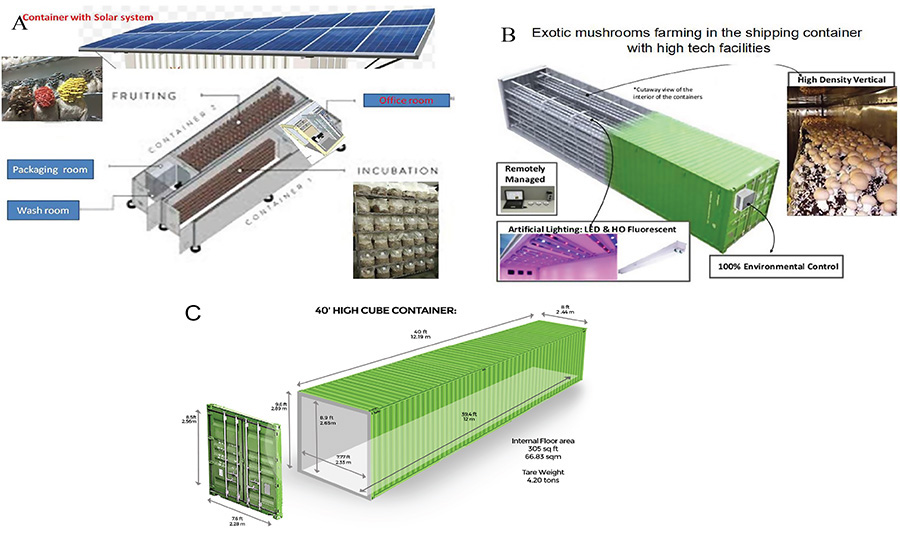
- Figure 2: Exotic mushroom cultivation using high-tech facilities (A-C)
- A complete mushroom farming operation typically requires multiple functional zones: substrate preparation, pasteurization, inoculation, fruiting, cold storage or packaging, and waste management. With the exception of substrate processing and composting, all zones should be located in close proximity to maintain sanitary conditions.Shipping container farms offer the advantage of being deployable in urban environments, reducing both transportation costs and environmental impact, and allowing for scalable production in areas with limited agricultural land.Economic advantages
- Low initial setup cost compared to traditional greenhouse farming.
- Predictable, consistent yields.
- Can be located near urban markets.
- Potential for direct-to-consumer sales.
A typical container mushroom farm might include (Fig. 2 A_endash_B): shelving systems with specialized growing bags or trays; LED grow lights with specific spectral outputs; humidity and CO₂ monitoring systems; automated misting and climate control; a substrate preparation area; and sterilization equipment. However, many different mushrooms can be cultivated, as explained below, along with an estimate of how many substrate blocks can be grown in a shipping container based on their size (Fig. 2 C).Maitake
Maitake mushrooms, also known as Hen of the Woods, are a highly prized culinary delicacy with origins in Japan and China, often compared to shiitake mushrooms in flavor and use. Maitake mushrooms require a specific substrate composition and a unique cultivation process for successful growth. Optimal growing conditions include a temperature range of 17_endash_22 degrees Celsius, 12_endash_14 hours of light per day, and humidity levels of 85_endash_95%. Commercial production of maitake mushrooms requires careful consideration of market demand, production costs, and the management of environmental conditions and resources. Creating these optimal growing conditions is essential for the successful cultivation of maitake mushrooms. They thrive best within specific temperature ranges, humidity levels, and environmental conditions, all of which can be achieved in compact facilities such as a 20- or 40-foot shipping container. One 40- foot container used as a fruiting room can yield approximately 750_endash_1,000 kilograms of fresh maitake mushrooms per month (Table 1).Shiitake
Shiitake mushrooms (Lentinula edodes) have gained popularity not only for their unique flavor but also for their numerous health benefits. They can be cultivated in urban environments, promoting local food sourcing. Innovations in supplementing substrates with nutrients have also improved yields considerably. Technology plays a significant role in modern shiitake cultivation. Automation systems help monitor environmental conditions closely, and smart sensors can control humidity, temperature, and air circulation, allowing for optimized growth conditions that can be created inside a shipping container. One 40-foot container can yield approximately 300_endash_400 kilograms of fresh shiitake mushrooms per month, based on shelving capacity and the growing requirements of the species (Table 1).Oyster mushrooms
Popular with beginners due to their fast growth and adaptability, oyster mushrooms can be cultivated on various substrates such as straw, sawdust, and coffee grounds, making them versatile and easy to manage. However, other mushrooms may yield more, such as button mushrooms (Agaricus bisporus), since the substrate blocks (when bags are used in place of industry standard beds) used for them are larger than those for shiitake and maitake. Additionally, fruiting in button mushrooms typically occurs on the top of the substrate bags. 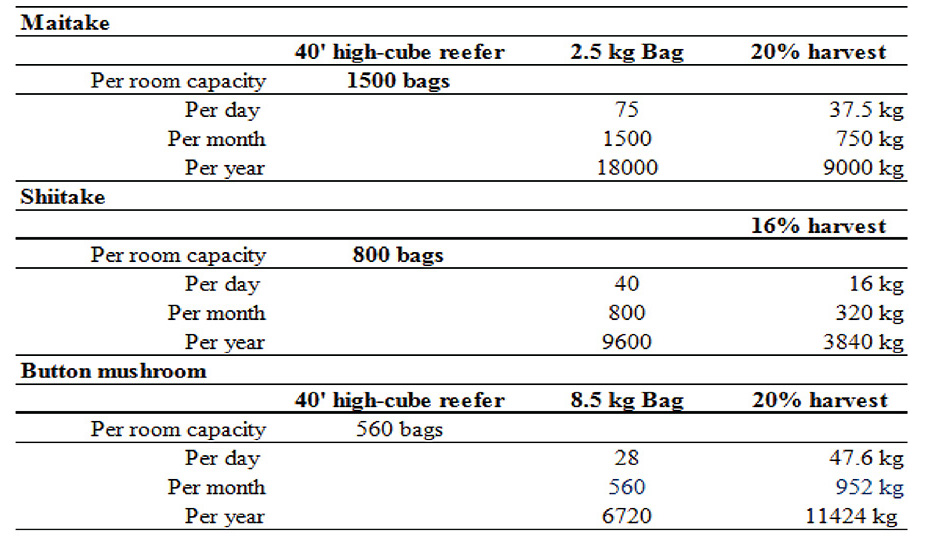
- Table 1: Approximated exotic mushroom farming capacity utilized using shipping reefer (refrigerated) containers
Conclusion
The key consideration for mushroom growers is whether to use low-tech or high-tech cultivation methods in compact facilities. This choice often depends on the scale of production, available resources, target markets, and the grower’s goals and preferences. Some challenges of low-tech farming include limitations on scale, reduced control over growing conditions, and greater vulnerability to contamination. However, low-tech mushroom farming requires minimal equipment and investment, makes use of recycled materials, and does not rely on synthetic fertilizers. Another key consideration is that compact facilities using shipping containers for growing mushrooms offer a cheap and viable option. Advantages include their availability, structural durability, portability, and the lack of required building permits. They are portable, modular, and stackable, and because they are not permanent structures on your land, in most states you will not need a permit. They are easy to outfit, and a number of companies make prefabricated turnkey units. Shipping containers are scalable, and adding additional units is easy. They are self-contained and can maintain stable growing conditions that will enable you to grow mushrooms all year. If you are interested in growing mushrooms, shipping containers may be the best compact fruiting facilities even for low- or high-tech exotic mushroom farming.Acknowledgments: The author would like to thank many researchers for their research article review used as references in this article and the author declares no conflicts of interest.Present affiliation: Researcher & foreign division chief at Fujishukin, Yamanashi


 1-2-13 Honmachi, Komoro city, Nagano prefecture, Japan 384-0026