
Login or Subscribe
You must be logged in to access this content
◆ Discover exclusive Japanese mushroom cultivation techniques
◆ Learn innovative methods to enhance mushroom quality and yield
◆ Tap into Japan's rich heritage for unique growing insights
Subscribe Now for Free Login
Bringing it all back home
Circular resource management for sawdust supply and used substrate at Daishin Inc.
While mushrooms cultivation allows for a high degree of control within growing spaces, and the potential for consistent harvests day after day, it is still reliant on other industries, and particularly forestry and agriculture, when it comes to the supply and disposal of mushroom substrate. The Japanese Exotic Mushroom Journal used a visit to a sawdust and compost supplier near our offices in central Nagano prefecture, Daishin Inc., as an opportunity to think about the resources that come in, and go out, of mushroom production, and the potential benefits of `joined-up`thinking in resource management in an unstable world.
Beyond the farm gates
More perhaps than many other parts of the agricultural industry, mushroom growers have always had to pay keen attention to how materials are made and disposed of in places outside of their farm: working out how to get hands on quality base substrate, what effects different nutrient mixes might have on their mushrooms, or what to do with the large amount of used substrate that is the natural byproduct of fungi cultivation. This has undoubtedly helped mushroom growing make a case for its green credentials (or at the very least a willingness to understand how production fits into other industries), showing not only how different agricultural waste streams can be utilised for further production - whether corn husks, soybean hulls, wheat/rice bran, or lees from alcohol production - but also how the waste from mushroom growing itself might find purpose beyond the gates of the farm, as a fertiliser or soil conditioner in agriculture.
But how easy is it to make this a reality? What do mushrooms producers need to know when thinking about the in- and out-flow of resources from their farm? The Japanese Exotic Mushroom Journal decided to seek out a company best placed to understand more about the ins and outs of the management of substrate resources, a specialised sawdust supplier for mushroom producers in the heart of mushroom farming in Japan, Nagano prefecture. Involved in the sawdust trade and supplying only mushroom producers since its establishment in 1985, Daishin Inc. has an impressive track record not only of supplying many of the prefecture`s mushroom growers cultivating various different mushroom species, but also thinking about how we might rework mushroom substrate supply chains and make them more resilient. It seemed like a perfect opportunity to get a sense of how resources can, and should, flow in and out of mushroom growing operations.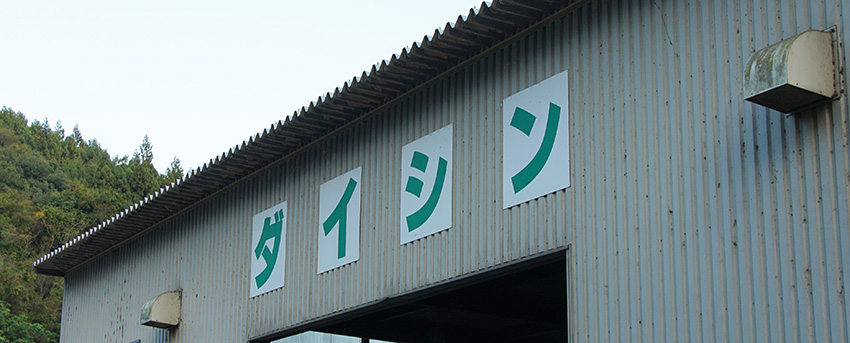
- The name of the company displayed on one of the many warehouses on the site.
- Sitting down with Daishin`s CEO Shūichi Satō, however, the first thing he talked about was some of the difficulties involved in the business of sawdust supply, and the small number of companies that took on the work, even in a country with a mushroom industry as developed as Japan. Sitting in the company`s small office, located in the middle of a working site filled with large piles of sawdust on three sides (right in the middle of the action, so to speak), he made these difficulties clear as he talked about the development of his company. Daishin Inc. started specifically with the aim of making use of an abundance of large quantities of sawdust that needed to be disposed of from sawmills in the neighbouring prefectures of Toyama and Niigata, wondering whether there might be a way to make use of it in the booming local enoki growing market. Seeing the potential for mushroom growing to make the most of waste flows, and the importance of infrastructure to facilitate these linkages, was part of the Daishin Inc. story from the beginning.Fast forward 40 years, and the industry has changed drastically in Japan: prices for enoki here are now consistently low, meaning that essentially all farms grow not using sawdust but cheaper imported corn cob meal (which also produces a slightly higher harvest per bottle).Demand for sawdust instead comes from producers of other mushroom species, with, for example, Japanese oak being used as a major substrate component for shiitake cultivation, and Japanese beech for growing shimeji. Furthermore, as Mr. Satō told me, sawdust produced as a byproduct from sawmills no longer `cuts the mustard`, so to speak, for mushroom substrate for other species, who have much more stringent demands when it comes to the quality of the product used.
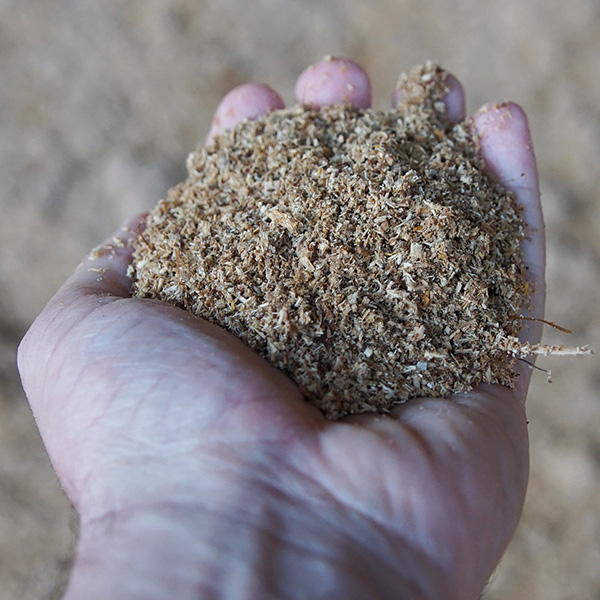
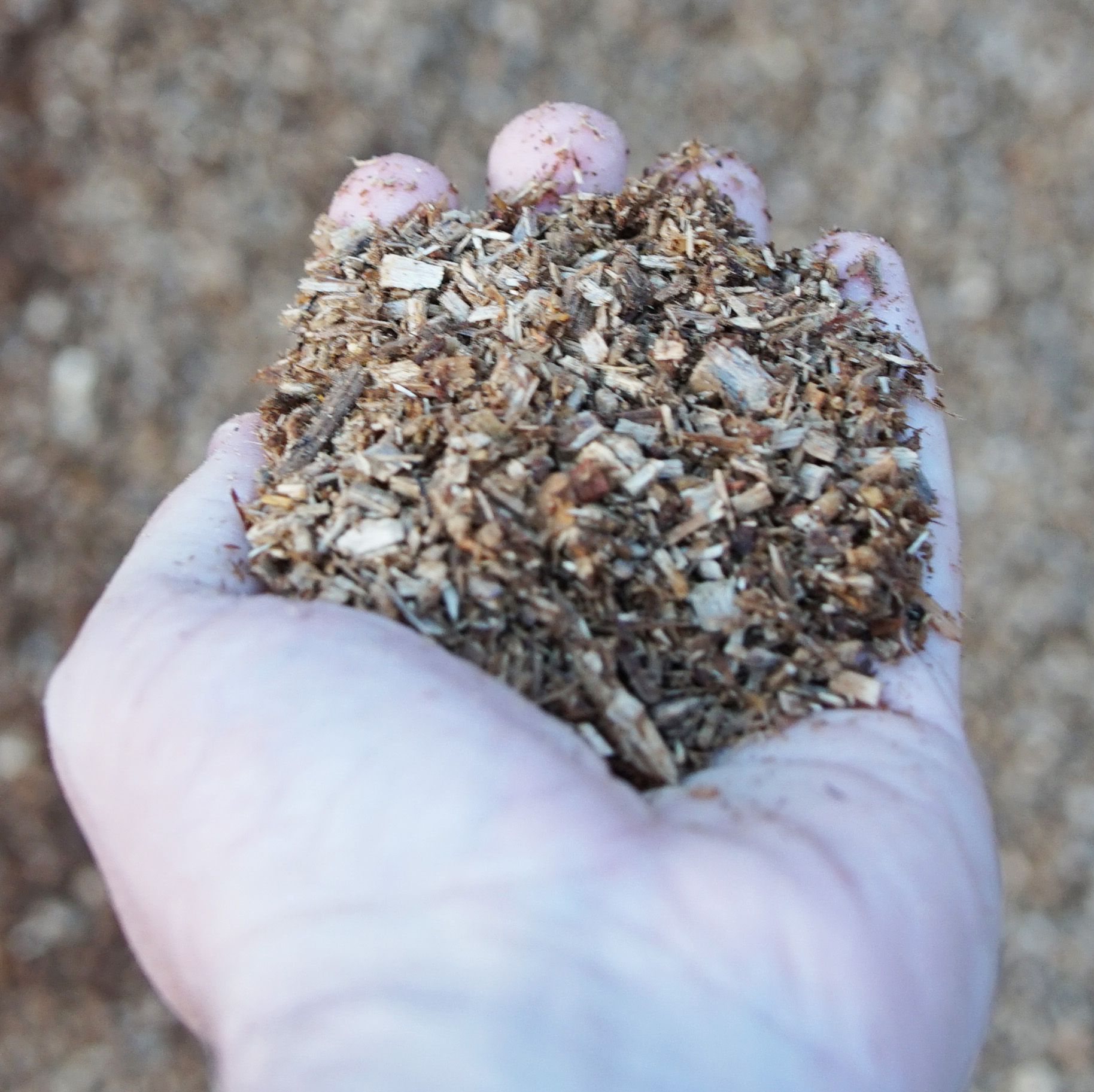
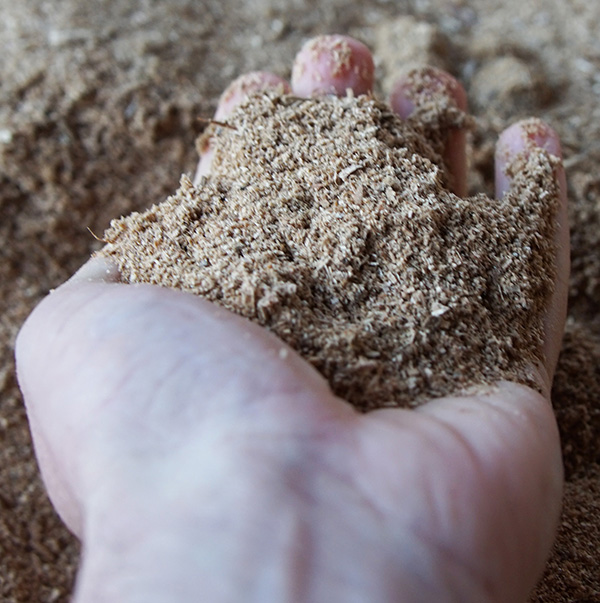
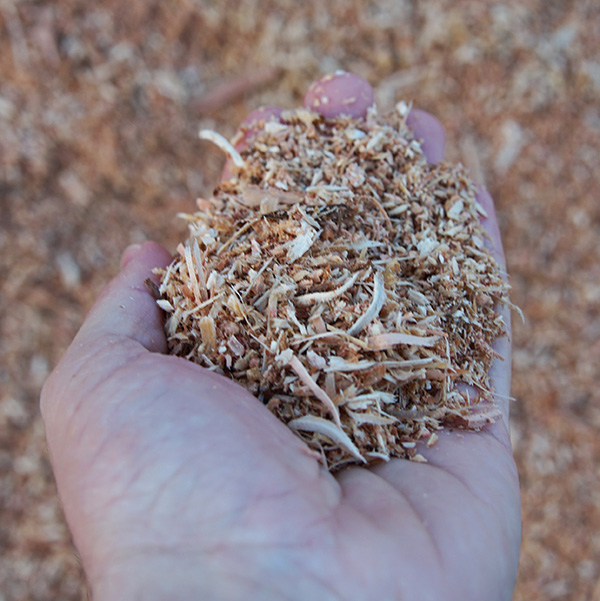
- A selection of the different sawdust supplied by Daishin Inc. to local mushroom growers. Clockwise from top right: Japanese oak, a coarse broadleaf hardwood mix, Japanese cedar, and Japanese beech.
- This of course talks to both the gap between the theory of utilising waste in mushroom growing and its practice, as well as the challenges involved in keeping up with an industry that is constantly changing. While the neat dovetailing of mushroom farming into the inputs/outputs of other industries seems to make perfect sense, there is plenty of work involved to get it set up, as well as issues of scale and critical mass to make it worth it for a dedicated waste resource supplier such as Daishin Inc. Producers, both in Japan and in other countries, often lament the ability to find reliable supplies of quality materials for substrate, talk about the difficulties in sourcing the `perfect` additions to substrate, and are often at a loss as to what to do with used substrate that piles up with each fresh harvest. This is in addition to regulatory frameworks that can limit how resources move in and out of farming operations, for example in exactly how used substrate can be disposed of. What can we learn, then, from Daishin Inc., about setting up and maintaining a business working within the space between mushroom, forestry, and agriculture industries?
Knowing one`s mushrooms
Conversing with Mr. Satō, it was clear that Daishin Inc.`s success over the past 40 years was in no small part thanks to a constant eye on its position between the different industries. Sitting down with him, he initially talked in great detail about the issues facing the lumber industry, and the shifts that had occurred during his company`s existence. This reflected an interest and deep knowledge about the materials that are coming in, how to manage them, and how to ensure they get to mushroom producers in the right shape. Walking around the site in between the many enormous piles of sawdust, Mr. Satō pointed to the different types of sawdust dealt with by Daishin Inc. - mostly purchased in as sawdust from the forestry industry but some also brought in as lumber and milled on site - and each earmarked for producers of different types of mushrooms in the local area. The sawdust was from a variety of different tree species: some single-species products such as Japanese oak, Japanese cedar, and Japanese beech, but also mixes such as one made from deciduous hardwood. 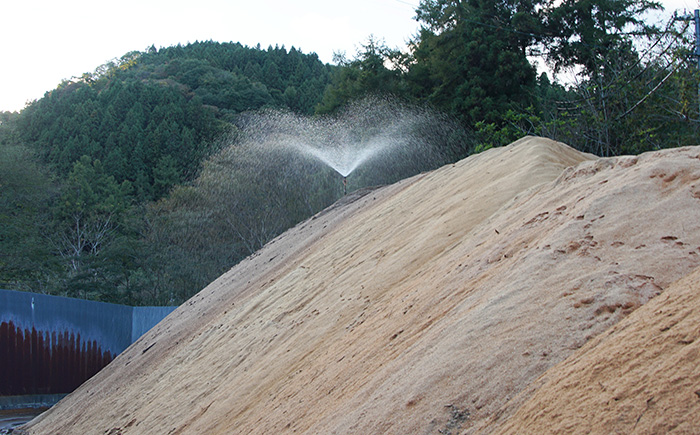
- A large sprinker placed on top of a pile of Japanese cedar. By watering the sawdust consistently over three months, the tannins can be washed out and it can be made useable for mushroom cultivation.
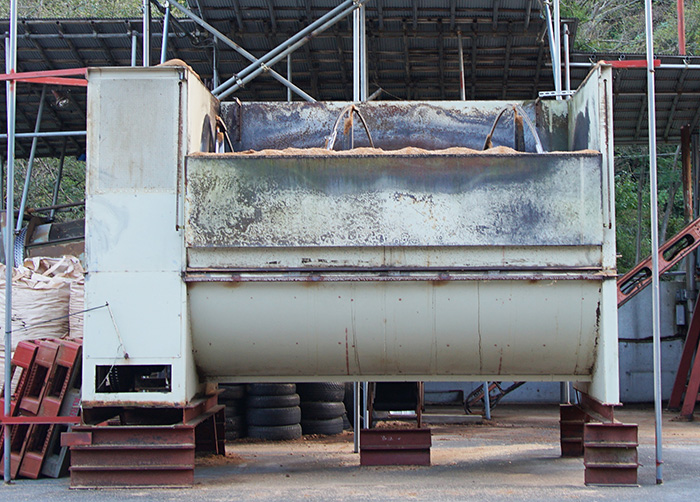
- A machine used to mix and sieve the sawdust to ensure even particle size, something which is demanded by mushroom growers because of its impact on growth.
- This interest and knowledge extended to the care taken in sawdust management. For deciduous sawdust, this was a case of controlling the fermentation of the sawdust, ensuring that it was covered, mostly in rooved storage facilities open on one side and except when being mixed before heading out to mushroom producers. Even so, there was still some degree of microbial activity in the sawdust, evident in the warmth that could be felt by sticking one`s hand into the pile; Mr. Satō also pointed out the effect that the fermenting sawdust was having on the metal walls of the storage facilities, a neat line showing to what point they were regularly filled. For the coniferous sawdust, and particularly the large quantity of Japanese cedar (the most planted tree in Japan and an oft-used building material) piled up at the site, the process was more complex, involving three months of fermentation and `washing` using sprinklers, in order to remove tannins and make it suitable for use in mushroom growing.Not only knowledge but also flexibility were important when it came to the mushroom producers who he supplied. Daishin Inc.`s business has grown with the local mushroom industry, and Mr. Satō was highly knowledgeable about how mushrooms were grown, what producers` needs were, and how he could fulfil them. One of the reasons his operation has been able to stay in business so long without customers `cheating` on him, as he described it, was to be responsive to the needs of individual operations. In practice this means being able to provide not only different types of sawdust from the species of tree, but also variation in coarseness of the sawdust, which affects the structure of substrate; this was then `sieved` on site to ensure it met exacting standards. Furthermore, Daishin Inc. could then offer custom mixes of sawdust for customers, blended on site and then delivered directly to them.These close relationships with the forestry and mushroom industries are obviously made partly possible in some ways by the critical mass of mushroom producers in the area, that make it worth Daishin Inc.`s while to produce a niche product for a specific industry. But the ability to stay successful despite the rapid changes in the industry (and the relatively small number of businesses that have succeeded in being a supplier) suggests that flexibility and communication have been a key to that success, to understanding the different needs of each part of the supply chain.
Thinking about the whole
While Daishin Inc. has been carving out a reputation for themselves in substrate supply, recently they have turned their attention to what happens to their substrate after it has been used for mushroom cultivation. Ten years ago, they began a new arm of operations, collecting used mushroom substrate from the producers they supply (and also other producers who also want to dispose of it), and composting it themselves to turn it into a product that can be used by local farmers, as both fertiliser and soil conditioner. 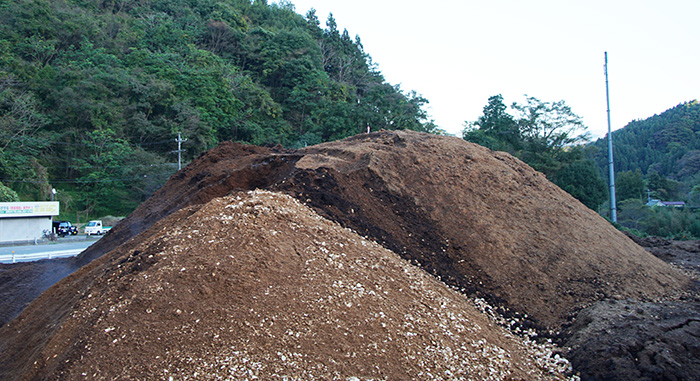
- Some of the used substrate that is composted at Daishin Inc. Local mushroom growers bring their substrate to the facility, where it is mixed with enzymes and composted for four months. The initial material (front) is, with time and frequent turning, soon able to become a valuable resource for local farmers (back).
- The process itself is simple, a case of bringing in ground, used mushroom substrate (from nameko, eryngii, enoki, and bunashimeji cultivation) and mixing it with an enzyme that speeds up the process of decomposition, allowing it to be turned into fully broken down compost within four months. Mr. Satō described how there was nothing special they had to do in terms of treating the used substrate beyond this, as all materials that are suitable for making substrate in the first place - sawdust, wheat/rice bran, corn cob meal, and so on - are organic substances which can be easily composted, and the pH level has also already been adjusted. Plus, of course, the saprophytic fungi have already done part of the job for them, in the production of their own enzymes that break down lignocellulosic materials in the substrate. While contaminated blocks could potentially be a concern, Mr. Satō claimed that they did not have any issues at Daishin Inc., as producers dealt with this themselves in the process of growing mushrooms, removing infected blocks and ensuring they do not end up in the composting heap.Daishin Inc. provides this excellent product to local farmers for an incredibly cheap price, if they can come and collect it from the site (though they do offer local delivery as well). In this way, they are able to `contribute` to the local community, and particularly local Japanese farmers who are struggling with the rising costs of agricultural inputs. It is also used on their own farm, another arm of the Daishin Inc. umbrella that grows potatoes, corn, and Japanese green onions to sell locally.It is clear that the Daishin Inc. has created a business model that can make good on the promise of the potential of mushroom growing to make use of waste materials and link up different industries. Furthermore, it seems that it has done this by taking a more interesting (and complex) approach to resource management beyond simply `finding the gap` in the waste market, and searching for profit there. Rather, it involves a willingness to look at the whole story of resource use - where they come from, where they end up, who uses them and how they are affected in the meantime - and make efforts to create a sustainable, cyclical system. As Mr. Satō was keen to tell me, what they were doing at Daishin Inc. is not unique: there were other places that used enzymes to speed up the composting of mushroom waste, and also numerous other sawdust supplier providing for a developed industry. What Daishin Inc. is able to do, however, is take its unique position between multiple industries to take a broader, joined-up view of how sawdust and other materials are produced and consumed, and take a responsible stance in regards to them; that is, a sense that the whole supply chain is of concern, even if only directly involved in a few specific parts of it.The flexibility and resilience of this approach is clear as well, as Daishin Inc. continues to thrive even as the industries it connects with change, made possible by local networks, communication, and mutual understanding. In a world where agricultural markets are being thrown into turmoil by climate change, spiking energy costs, tariffs, and broader global instability, the diversity, flexibility, and resilience of approaches to sawdust and other resources taken by Daishin Inc. are worth paying attention to.For mushroom producers, able to have a high degree of control within the farm, taking an interest in the movement of materials outside of it could be a sensible move. As exotic mushroom growing expands across the globe, there are no doubt sustainable and interesting opportunities for connections between fungi cultivation, forestry, and agriculture, with the right eye.
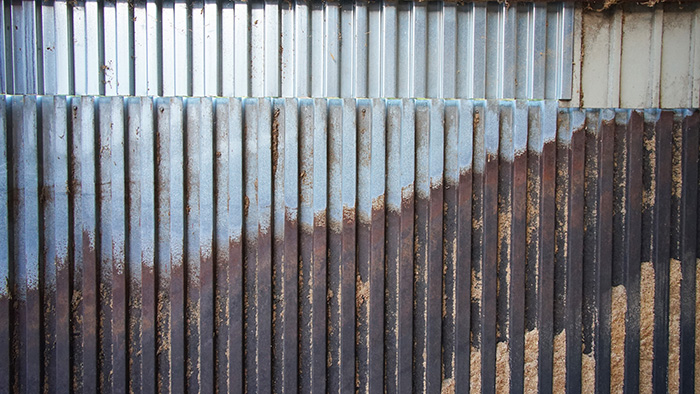
- A picture of the side of a metal wall in a covered sawdust holding. The line running from bottom left to top right is the slope of sawdust normally piled up against the metal.


 1-2-13 Honmachi, Komoro city, Nagano prefecture, Japan 384-0026